
Products
Case studies
Industries
Resources
I’m an Influencer
14 min read



Table of Contents
When it comes to UGC creators vs influencers, what actually sets them apart? And which partnership is better for your user-generated content campaigns?
At first glance, they seem similar. Both UGC creators and influencers create people-focused content that often features real experiences with products or brands. But when you look a little closer, their roles start to diverge. Influencers create content and build an audience around a topic or niche, while UGC creators produce product-centred content designed for brands to distribute on their channels.
Understanding this distinction matters. Each one delivers a different outcome, requires different forms of collaboration, and plays a unique role in the customer journey. Recognising these differences helps you and your brand make smarter decisions about your campaign strategy, budget, performance expectations and more.
In this article, we’ll compare UGC creators vs influencers, outline their strengths and limitations, and explore how successful brands use both to scale content and drive results.
A UGC creator is a type of creator, outside of a brand’s direct control, who creates content featuring the brand’s products or services, whether a photo or video. In short, they act like freelancers who create more authentic, UGC-style content for brands to distribute and repurpose across their websites, social media, email campaigns, etc.
Alongside organic UGC (from satisfied customers and other creators), paid UGC is becoming increasingly more common nowadays. These UGC creators, typically compensated by brands through cash, discounts, or products, produce high-quality content pieces of themselves using the products in a natural setting.
These practical demonstrations have become the norm rather than the exception, and they are used by brands across their channels and throughout the customer journey.
An influencer is a specific type of creator who builds a community on social media and creates content tailored to that community. Their focus is on having an established audience with defined demographics and interests.
Like UGC creators, influencers are external to brands, although they can establish agreements to act as brand ambassadors. Unlike UGC creators, influencers must distribute the generated content through their own channels to maximise the reach of the piece and give visibility within their audience.
Influencers collaborate with brands on UGC campaigns as part of their influencer marketing strategies, whether posting a review, sharing their experiences through video, or simply with a post that tags the product or service.
Finding the right influencers for your brand and campaign is essential. Influencers are tiered based on their following and engagement, ranging from nano-influencers with fewer than 1,000 followers to mega-influencers with millions.
Most fail to realise that an influencer’s following does not have to be large to have a significant impact. In fact, some of the influencer marketing campaigns with the highest ROI come from nano and micro influencers, as their communities are more tight-knit.
Whether it is through Instagram, TikTok, YouTube, or Pinterest, influencers have a community that oftentimes is influenced to mirror their purchase decisions. With a well-run campaign, your business can capitalise on and integrate the influencer’s community with your own, driving conversions like never before.
Skoringen has a dedicated page for brand ambassadors to highlight the products that they love and use. They showcase customised galleries for each influencer. Let’s explore how Skoringen leverages influencer collaborations:
When partnering with influencers, you will obtain all the benefits of UGC creators (like high-quality and cost-effective content and authenticity), in addition to validation and exposure in a specific community. The higher the reach, the bigger the exposure, but this also reduces engagement and conversion rates.
Explore our comparison article on Consumer-Generated Content vs. Influencer-Generated Content to learn more about these two types of UGC.
With the similarities of UGC creators vs influencers explained, now let’s explore the key differences between them, so you can choose the appropriate partnership for your next campaign:
| Aspects | UGC Creators | Influencers |
| Value Proposition | Sell content: authentic, brand-ready visuals for marketing. | Sell influence: access to a trusted, engaged audience. |
| Content Ownership | Brands usually own or license content for long-term reuse. | Influencers own content; brands get limited usage rights. |
| Cost Structure | Lower cost, paid per content piece or project. | Higher cost, pricing based on reach and community size. |
| Building Trust | Relatable and real. Feels like “content from people like me.” | Driven by personality and credibility within a niche. |
| Campaign Objectives | Suited for social proof and direct response marketing. | Best for awareness, storytelling, and brand image. |
| Customer Journey Role | Works best mid-to-bottom funnel (validation, conversion). | Works best top-of-funnel (discovery, awareness). |
| Measurement & KPIs | Tracked by CTR, ROAS, and conversions. | Tracked by reach, engagement, and sentiment. |
UGC creators’ main asset is their content: authentic, brand-ready assets that can be used across a company’s entire marketing ecosystem. Their focus is on producing videos, images, or reviews that feel organic but are designed for performance.
Brands leverage this content in paid ads, email marketing, product pages, and social media feeds to build credibility and social proof. UGC creators help brands scale their content production efficiently, ensuring that marketing materials always feel fresh and relevant to consumers.
Influencers’ main asset is their audience, who trusts their opinions and follows their recommendations. The real asset here is influence, the ability to inspire interest, desire, or loyalty through personal connection.
Brands partner with influencers to reach new audiences, boost awareness, and associate their products with aspirational lifestyles. Their content performs best within their own social channels, where their personality amplifies the brand’s message.
With UGC creators, content is commissioned work: created for the brand, often under a “work-for-hire” or licensing agreement. This typically gives the brand full or long-term rights to use the content across any channel, including social ads, websites, paid campaigns, and printed materials.
This flexibility is a major advantage: once produced, the content can be repurposed across multiple campaigns without additional fees.
Influencers usually retain ownership of the content they produce unless otherwise specified in the contract. Brands often receive a limited license to use the content, for example, reposting it on the brand’s social media or using it in ads for a set period (e.g., 90 days, 2 years, etc.).
Extending that license or using the content in paid campaigns typically requires additional payment. Because influencer content is tied to their personal brand and feed, usage rights are more restricted and must be carefully negotiated.
UGC creator collaborations tend to be budget-friendly and performance-focused. Brands pay per piece of content or per project rather than based on audience size. The pricing reflects the creator’s skill, production quality, and deliverables, not their following.
This structure makes ROI more transparent since the content is directly tied to marketing assets and measurable results like click-throughs or conversions.
Influencers charge more because brands are paying for access to their audience, reach, and reputation. Costs are influenced by several factors: follower count, engagement rate, niche relevance, and platform (Instagram vs. TikTok, for example).
In addition, high-profile influencers often include additional fees for exclusivity, licensing, or extended content usage. While more expensive, influencer collaborations can generate strong top-of-funnel awareness and brand credibility when executed strategically.
Trust in UGC creators’ content stems from relatability. Consumers view UGC as content created by “people like me,” rather than paid endorsements. The tone is casual and unpolished, often mimicking the organic style of everyday social media posts.
This makes it powerful in building authentic social proof: the sense that real people genuinely use and enjoy the product.
Influencers build trust through personality and authority. Their followers have chosen to listen to them over time, which gives their opinions significant weight. When an influencer endorses a product, it carries a layer of credibility based on their perceived expertise or authenticity within a niche.
However, this trust can be fragile: overly promotional or mismatched collaborations may appear insincere and reduce impact.
UGC is a strong driver of direct response marketing: ads or posts that encourage immediate action, such as clicking, adding to cart, or purchasing. It’s also valuable for building social proof and product understanding, showing how real people experience and use the product. Brands use UGC to make marketing content feel more trustworthy and relatable at every touchpoint.
Influencer campaigns typically aim for brand awareness, storytelling, and perception-building. Influencers infuse products into their personal narratives, making them feel aspirational or desirable. This approach works well for reaching new audiences, introducing products, or repositioning a brand within a cultural context.
UGC creators’ content performs best in the middle and bottom stages of the funnel. It reassures potential buyers who are considering a purchase by providing authentic validation from real users. When placed in retargeting ads or product pages, UGC helps eliminate doubts and boosts confidence in the product’s value and quality.
Influencers shine at the top of the funnel, introducing brands to new audiences and generating awareness. Their storytelling capabilities and aspirational positioning spark curiosity and interest. This makes influencer content ideal for launching new products, expanding into new markets, or reshaping brand perception.
Because UGC is integrated into brand-owned channels, UGC creators’ content is evaluated through conversion-focused metrics: click-through rates (CTR), add-to-cart ratios, purchase rates, and ad performance (ROAS). UGC’s effectiveness can be measured immediately through A/B testing or campaign analytics, making ROI easy to track.
Influencer success metrics are generally reach- and engagement-based: impressions, likes, comments, shares, and follower growth. Some campaigns include trackable links or promo codes to assess conversions, but influencer ROI often manifests over time as improved brand sentiment and awareness. The impact is more qualitative than quantitative.
Now that you know the difference between UGC creators and influencers, the next step is to start managing campaigns with influencers and UGC creators.
You can find influencers for free by utilising social media platforms’ search features, browsing relevant hashtags, joining industry-specific groups, and engaging with creators who align with your brand. You can find UGC creators for free in forums, social media platforms, and even on Reddit communities like r/ugc, r/UGCForBrands, and r/UGCcreators.
This is a good option for small brands developing a content marketing strategy and starting their first campaigns with external creators. However, if you really want to scale your user-generated content strategy, the best option is to use a UGC platform that allows you to:
An influencer marketing platform streamlines your entire influencer collaboration process, making it smoother and more effective. They also give you valuable insights to see what’s working, optimise your strategy, and turn influencer partnerships into authentic content that builds trust and drives real results for your brand.
Here is a list of the best influencer marketing platforms for brands. Keep in mind that the best platform is the one that would allow you to handle all UGC, including influencer marketing strategies. An all-in-one platform is more cost-effective and easier to manage than multiple platforms for various purposes within the brand’s content strategy.
Securing content rights ensures your brand can use creator or influencer material safely and compliantly. Without explicit permission, republishing or repurposing content (for example, using an influencer’s video in an ad or on a website) can lead to copyright infringements or content removal requests.
Requesting content rights gives you legal security and creative freedom. It allows you to repurpose authentic content confidently without risking your reputation or compliance issues. Flowbox simplifies the process of obtaining rights to use UGC with a streamlined, efficient system designed for clarity and ease. Here’s how it works:
At Flowbox, we help you request and manage rights for social media posts. We ensure easy management of your pending requests and help you automatically moderate posts once their rights have been granted. To ensure proper management of your content, we highly recommend requesting the rights for all your collected posts.
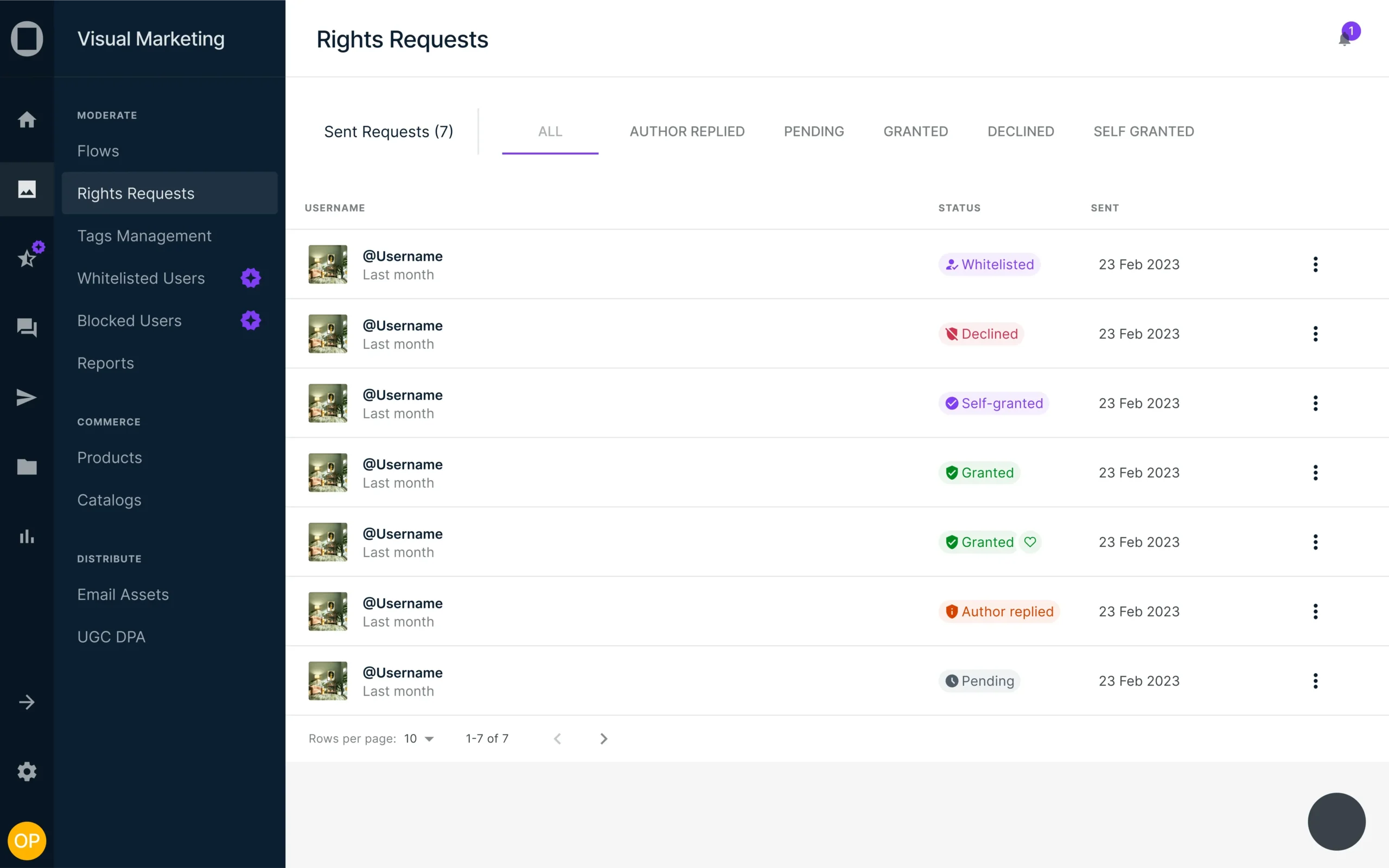
If you have a previous agreement with a creator, you can skip the rights requests every time they post by adding the user to your whitelist. Their post will be automatically marked as ‘Whitelisted’ if collected via @Mention or Tag.
On your website and social media accounts, we recommend having a clear and easily accessible section for your Terms and Conditions or legal page. Let’s take a look at how the Swedish brand Åhléns is leveraging its Terms and Conditions page. The brand explains the terms and conditions of using the #yesahlens.
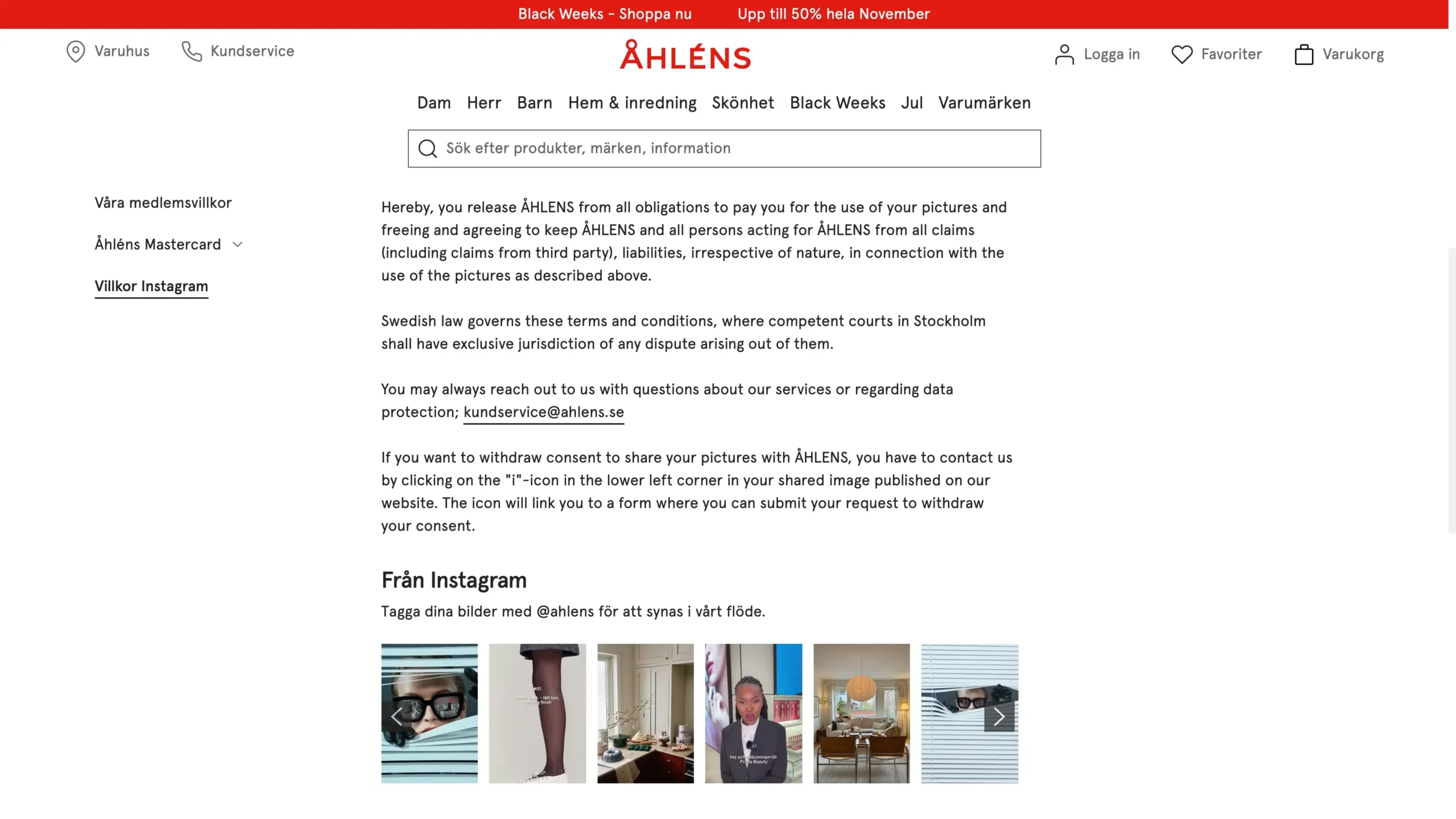
Åhléns has even added a UGC gallery to the page, allowing their users to easily understand how the brand would utilise their content and encourage the rest of the community to share it as well.
When working with UGC creators or influencers, a contract is essential to set clear expectations and protect both parties. It defines the scope of work, content ownership, deadlines, usage rights, and payment terms, ensuring there’s no confusion later on.
Without a contract, even small miscommunications, like unclear posting schedules or ownership disputes, can turn into costly problems. A contract fosters trust, transparency, and legal protection, providing both your brand and the creator with confidence to collaborate smoothly.
Strong UGC platforms ensure you are backed by a Contract with the UGC creators or influencers you work with by default, since it’s included in their Terms and Conditions that creators accept when joining the platform. This small step guarantees your brand’s protection when collaborating with content creators, saving time and avoiding potential legal issues with influencers and UGC creators.
Customers interact with brands across multiple channels, from websites and emails to social media platforms. To create a seamless and engaging brand experience, brands must integrate their user-generated content efforts across these touchpoints.
A cross-channel UGC strategy involves leveraging multiple marketing channels, such as websites, email campaigns, and social media, to deliver a seamless and unified brand experience. By leveraging authentic customer content across different channels, brands can boost trust, enhance engagement, and drive conversions.
A successful cross-channel strategy incorporates user-generated content across multiple digital and offline touchpoints. Here’s where brands can effectively integrate UGC:
Thanks to the Flowbox platform, EVOC Sports simplified the management and integration of a cross-channel UGC strategy. EVOC incorporated a UGC strategy into their eCommerce platform, social media, and email assets, which currently features flows on their homepage, product pages, and community page.
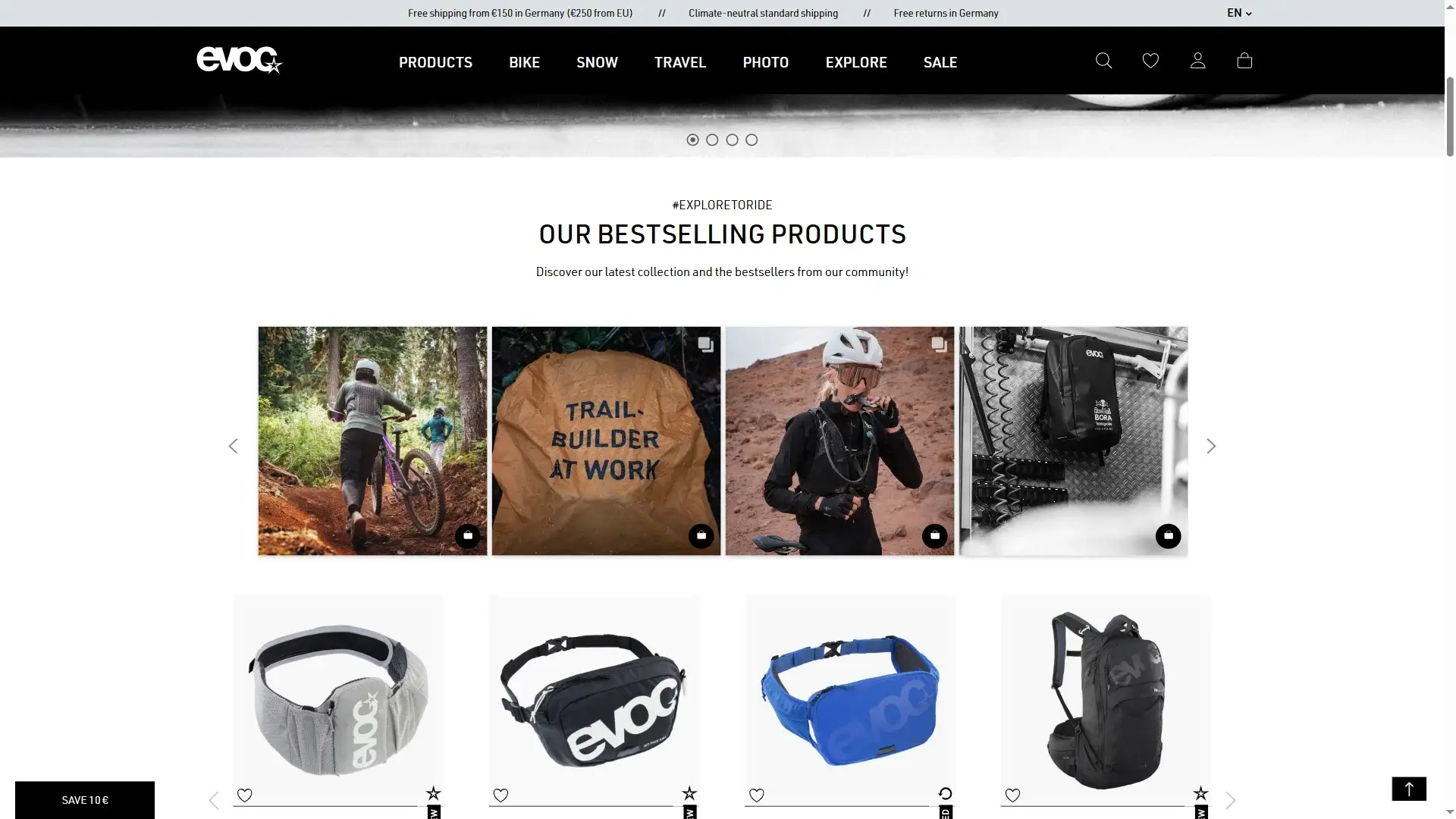
The implementation of UGC has helped EVOC Sports humanise their brand and provide social proof, particularly important for technical products. It allows potential customers who aren’t currently in the mountains or actively participating in outdoor sports to connect with the brand through authentic user experiences.
This approach led to hugely increased engagement rates: in the last 3 months, 83.23% were engaged with the UGC flows content (Post-Engagement per Engagement), and 11.40% clicked on the CTA button “Buy” to visit the product pages (CTA Engagement per Engagement).
Even though you can handle all your campaigns and payments for free using tools like spreadsheets and DMs, we strongly recommend you use a UGC platform or an influencer marketing platform to scale your influencer and UGC creator campaigns.
A platform would allow you to:
Flowbox allows you to define your own reward system for creators, customising it for each campaign and deciding between cash, discount vouchers, or custom rewards. All managed within the platform.
The most successful brands don’t choose between UGC and influencer marketing. They use both to support different needs throughout the customer journey.
Customer journey is no longer linear. People move back and forth between discovery, consideration, and purchase, and they look for social proof at every stage. This means brands benefit from having a mix of authentic content formats available wherever customers are spending time.
Together, they offer authenticity, reach, and performance across the full customer experience.
Influencers, in comparison to UGC creators, serve different purposes, but when used together, they can reinforce one another and create a smoother path from discovery to purchase. The key is to define how each will contribute before production begins.
Here’s how to bring both into one campaign effectively:
When you set clear expectations and intentionally combine both creator types, your campaign benefits from storytelling at the top of the funnel and social proof that converts at the bottom. This transforms content into a connected journey rather than a collection of isolated touchpoints.
For marketers, finding the right balance between UGC and influencer marketing is what keeps your strategy fresh, scalable, and authentic. UGC fuels trust and performance by showing real customer experiences, while influencers open the door to new audiences and awareness.
When both work together, your brand builds credibility, drives engagement, and creates a consistent story across every touchpoint. Balancing UGC and influencer marketing helps brands stay relevant, scalable, and trustworthy. Each format plays a different role, and together they support a more complete customer journey.
UGC shows real experiences that build trust quickly, while influencers use their voice and audience to introduce your brand to new communities. This combination brings both credibility and exposure.
Because people discover, research, and purchase in no set order, social proof needs to appear at every stage. Influencers spark interest, and UGC reinforces confidence, encouraging consumers to move toward a purchase.
Using both formats gives brands more stories to tell across social feeds, product pages, emails, and ads, keeping content engaging without fatigue. For marketers, this blend means higher trust, improved performance, and more effective storytelling throughout the entire customer experience.
Both UGC creators and influencers play powerful yet distinct roles in brands’ content marketing campaigns. Influencers drive awareness and aspiration, while UGC creators deliver authentic, conversion-ready content that fuels performance marketing. And when you add organic customer content into the mix, you create a full-funnel strategy built on trust, relatability, and reach.
The best choice is to combine all types of UGC, from creators, influencers, and customers, to build a scalable, high-performing content ecosystem for your brand. A UGC platform like Flowbox, where you can collect, manage, and distribute UGC, and connect with creators, can help you scale your UGC strategy and drive real results.
Book a demo with Flowbox to see how top brands manage and activate UGC from creators, influencers and customers.
UGC creators make content for a brand’s channels. Influencers post to their own audiences. Some can do both.
UGC creators are usually cheaper, as influencers cost more due to their larger audience size and licensing requirements. Customers’ UGC can be free.
UGC creators’ and influencers’ content performs well in ads, outperforming both branded content and traditional ads.
No. Their value lies in the content production itself, not in reach.
Utilise social media platforms and Reddit to find creators for free. Scale your search and management with a UGC platform or an influencer marketing platform.
You don’t need a contract for collecting and repurposing organic UGC, but make sure to request the media rights from the creator. For paid UGC campaigns, we recommend having an agreement to avoid any potential legal issues. A platform usually covers this by default.
Use an all-in-one platform to manage collection, rights, publishing, and analytics. Discover and manage influencers and UGC creators, build your teams, and find the top-performing UGC.