
Products
Case studies
Industries
Resources
I’m an Influencer
13 min read



Table of Contents
The question of consumer-generated content vs. influencer-generated content comes up in almost every content planning conversation, and it rarely gets a clean answer. Both content types drive trust, show up in feeds and on product pages, and contribute to the social proof that moves browsers toward buyers.
But consumer-generated and influencer-generated content work differently, cost differently, and serve different moments in the customer journey. Choosing one over the other isn’t a strategy. The brands getting the most out of their UGC strategy have stopped asking “which one?” and started asking “how do we activate both?”.
Consumer content provides the peer-level authenticity that no brand campaign can replicate; influencer content delivers the reach, consistency, and campaign structure that organic community posts alone cannot guarantee. Together, they form a full-funnel engine that reduces content production costs and increases conversion at every stage of the journey.
This guide breaks down the structural differences between consumer-generated content vs. influencer-generated content, where each performs, how top brands use them in combination, and what it takes to build a unified strategy that scales. If you’re managing content across channels, from product pages to paid ads and emails, this is where to start.
To understand the key differences between these two concepts, let’s start with what they have in common.
Consumer-generated and influencer-generated content are two sources within the user-generated content ecosystem (UGC includes content from customers, creators, influencers, brand ambassadors and the wider community), not two entirely separate disciplines. They are both generated by users outside of the brand scope and owned channels.
Both consumer-generated and influencer-generated content help brands to generate social proof, increase authenticity and trust, and ultimately drive sales. Then, how can brands choose which one to prioritise and where?
This is exactly why understanding the differences between influencer-generated content and consumer-generated content is crucial. It helps you deploy each type at the right moment in the customer journey, rather than using one to compensate for the shortcomings of the other.
Consumer-generated content is authentic social content created voluntarily by genuine customers: photos, videos, stories, and reviews shared on Instagram, TikTok, Pinterest, YouTube, and other platforms, without a paid relationship with the brand. This can take the form of a customer tagging your brand in an unboxing video or a buyer filming a before-and-after using your campaign hashtag.
Consumer-generated content carries no commercial bias. Buyers created it to share their own experiences or preferences, not to fulfil a brand brief. 79% of individuals report that UGC highly impacts their purchasing decisions. That trust signal is difficult to manufacture and impossible to fake, especially when users’ aesthetics or lifestyles match the brand’s.
Take Cibo Vloeren‘s example: the brand implemented UGC galleries on their website and included a ‘Upload Media’ button for customers to share content directly, without the need to publish it on social media.

The challenge with consumer-generated content is predictability. Volume and quality depend on community size, brand awareness, and how actively a brand encourages sharing. This is why it is important to know how to activate your community, to really benefit from customer-generated content.
UGC drives growth even for small community brands. It’s no issue for high-volume brands that can generate thousands of tagged posts per week, but newer or niche brands may struggle to reach critical mass without a deliberate activation strategy. That’s where influencer-generated content can help you boost authenticity as you consolidate your community and customer loyalty base.
Influencer-generated content is content created by influencers, UGC creators, and brand ambassadors in exchange for payment, gifting, or a formal partnership. The creator produces content aligned with their style and voice, but the brief, hashtags, posting timeline, and creative direction are shaped by the brand’s campaign objectives.
Influencer-generated content is more consistent and controllable than organic consumer content. Brands can specify visual style, key messages, posting formats, and frequency.
For a product launch, seasonal campaign, or new market entry, influencer content gives brands the creative velocity and reach that an organic community cannot provide on demand. They also encourage other community members to generate more content around the brand.
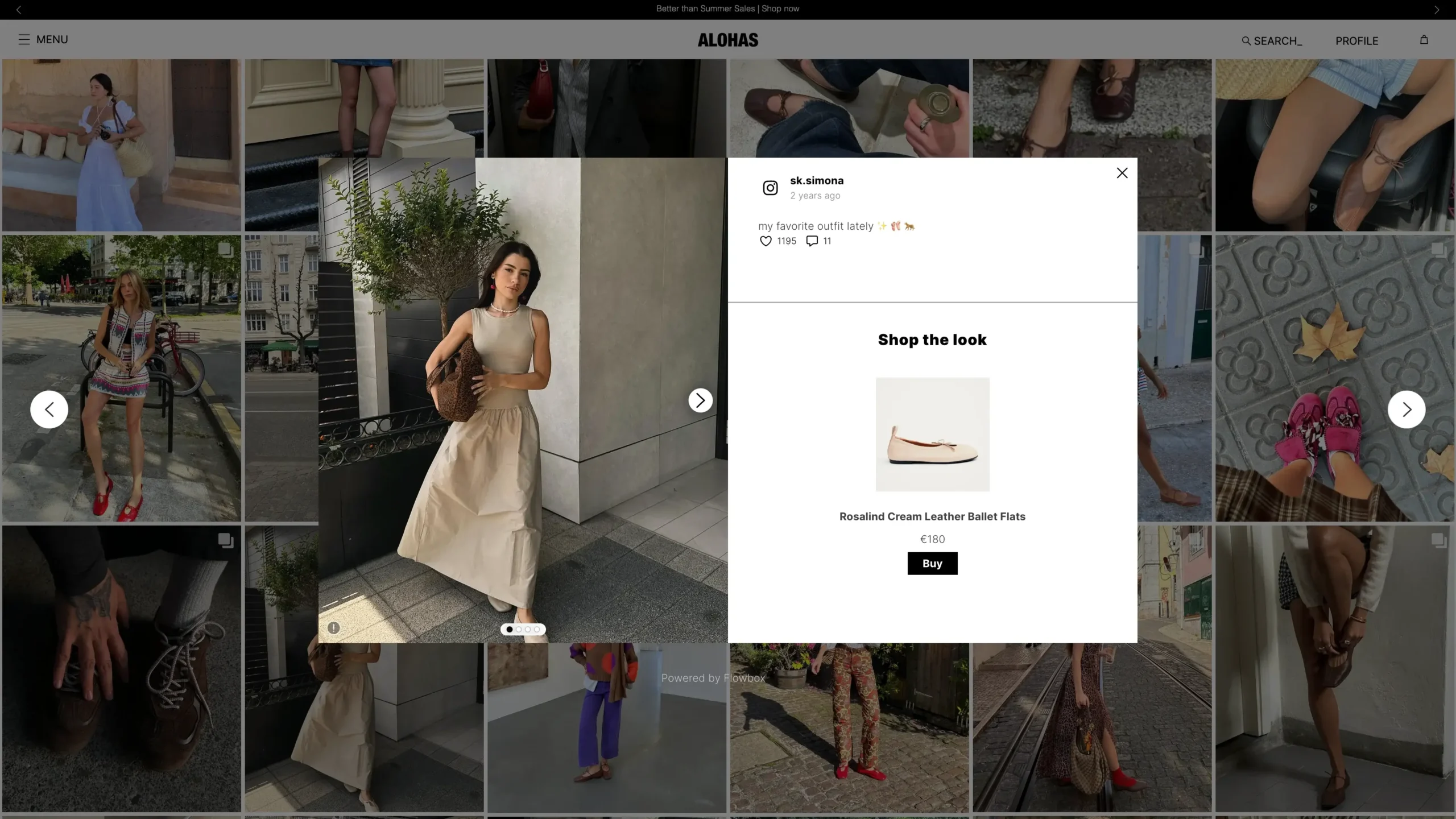
The trade-offs of influencer-generated content are cost and perceived authenticity. Consumers are increasingly aware of paid partnerships, especially on platforms like TikTok and Instagram where disclosure is mandatory. When influencer content feels over-produced or misaligned with a creator’s usual tone, it loses the social proof advantage it was meant to deliver.
The most effective influencer-generated content is brand-aligned but genuinely creator-led: brief-informed more than brief-dictated.
Consumer-generated and influencer-generated content solve different problems. One gives you peer trust at low cost; the other gives you reach and creative control on a schedule.
The table below sets consumer-generated content against influencer-generated content across the 8 dimensions that shape most content decisions. Each dimension is explained underneath.
| Dimension | Consumer-generated content | Influencer-generated content |
| #1 Source: Who creates the content | Customers. Organic | Creators. Paid or rewarded |
| #2 Authenticity signal | High. Unprompted, no commercial relationship with the brand | Medium and variable. Depends on the creator’s fit and community trust |
| #3 Volume and scale | High and ongoing once activated. Scales with community size and brand engagement | Controlled and predictable. Defined by campaign scope and budget |
| #4 Cost per asset | Low once the community is active. Indirect cost of incentives, contests, and community management | Medium to high, depending on the influencer. Includes creator fees, gifting, and management overhead. Still lower than professional photoshoots. |
| #5 Reach | Limited to each customer’s own follower base | Scalable. Target creators by audience size and profile |
| #6 Brand control | Low. Organic and spontaneous. Brands control what’s reused, not what’s shared | Moderate to high. Governed by brief and approval workflow |
| #7 Best use case | Social proof at scale, building trust and driving sales | Awareness, product launches, audience acquisition, new markets |
| #8 Customer journey touchpoint | Best on community, category, and product pages. Close to conversion | Best on social posts, ads, and homepage. Awareness and consideration |
The source is the clearest dividing line. Consumer-generated content comes from customers who post about a product on their own initiative. Influencer-generated content comes from creators a brand recruits, briefs, and rewards.
That difference changes the work involved. Sourcing customer content is a collection and moderation task (simple to execute with powerful automation tools like Flowbox’s), meaning you find what exists and secure the rights to reuse it.
XXL Nutrition activated a customer base that was already posting about its products but had nowhere to showcase it. Its Online Marketeer, Tom Meijer, describes the starting point:
“We intended to add more visual representations of our products and we were aware of our loyal customer base, already sharing pictures of our products.”
Tom Meijer, Online Marketeer at XXL Nutrition
Sourcing influencer content is closer to running a small supplier programme, with recruitment, briefing, and payment to manage. Crucially, the two are not rivals. The same community that posts freely can contain the creators a brand formally partners with, sometimes for long-term collaboration programmes.
Skoringen has long-term collaborations with influencers that match their aesthetic and style, and showcases their content on dedicated ambassador pages, keeping a steady stream of content for the brand’s new products and campaigns.
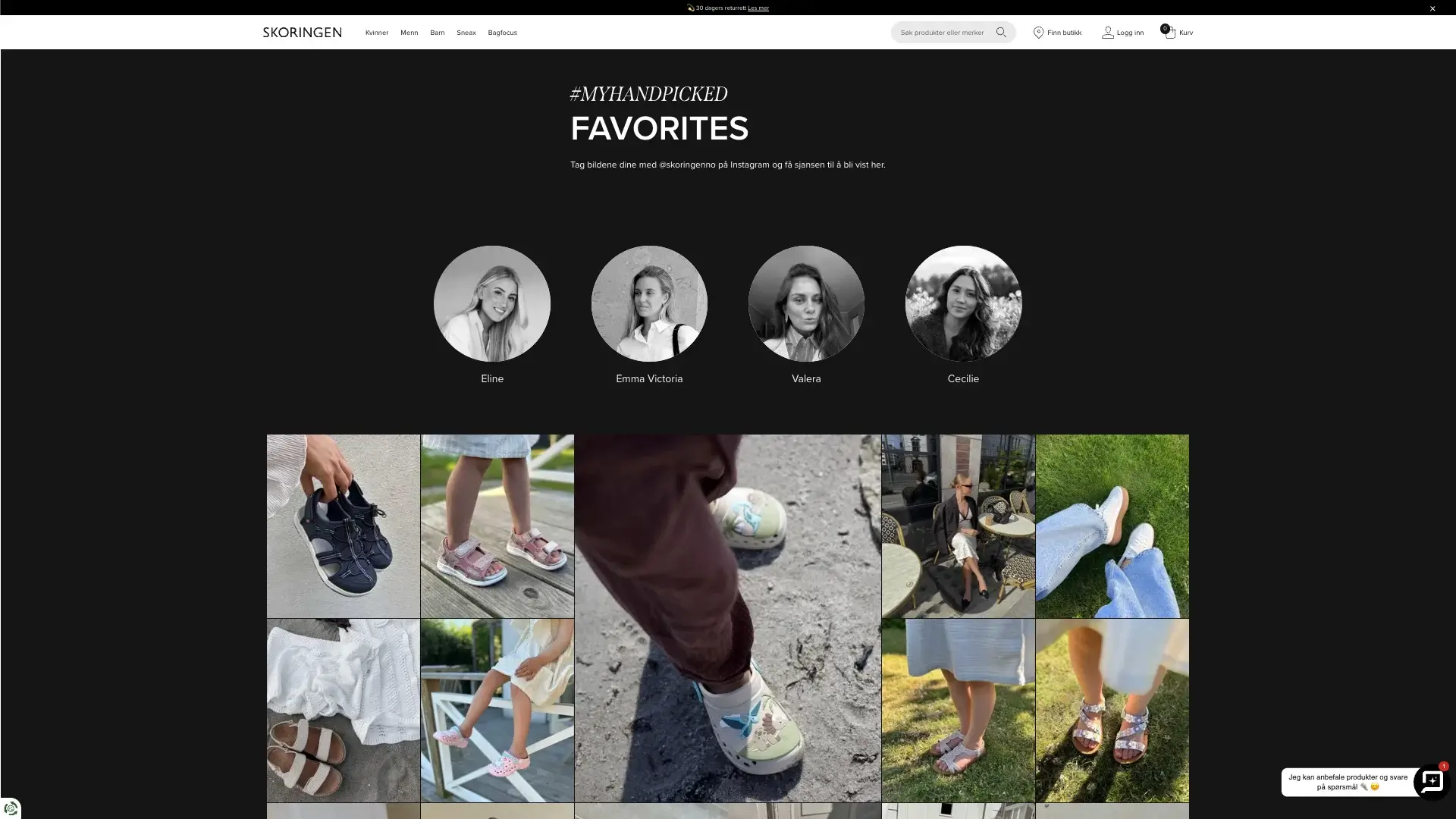
The source is determined on a case-by-case basis, since influencers can also become customers and not every piece of content created by influencers is necessarily part of a paid campaign.
Consumer-generated content carries the strongest authenticity signal because the customer has no commercial relationship with the brand. Influencer authenticity is real but variable, since it depends on how well the creator fits the brand and how much their community trusts them.
Sklum’s CMO frames why the unprompted authenticity signal matters:
“We believe that UGC is organic and authentic content that builds trust in the brand.”
Oana Andrada, CMO at Sklum
This is why even brands with excellent studio libraries still invest in customer content. The building materials brand Porcelanosa holds a large bank of professional imagery yet found that polish alone falls short:
“We have a lot of high-quality studio material that we use in our catalog, but it doesn’t always convey the authenticity value that user-generated content has.”
Porcelanosa Communications Team
That signal pays off commercially. When G-Star swapped polished product shots for real people in its ads, it recorded a 14% increase in click-through rate alongside an 18% increase in conversion rate.
Consumer-generated content scales with your community and keeps flowing once activated. Influencer-generated content is capped by campaign scope and budget, which makes it predictable but finite.
High-volume catalogues benefit most from the customer stream. Maxi Ortmeier explains how EVOC Sports benefits from UGC:
“About 20% of our products are top sellers, and all the others are smaller in volume, and generally you don’t see those products as often. So it’s really good to have some community pictures of them.”
Maxi Ortmeier, Senior Performance Marketing and E-Commerce Manager at EVOC
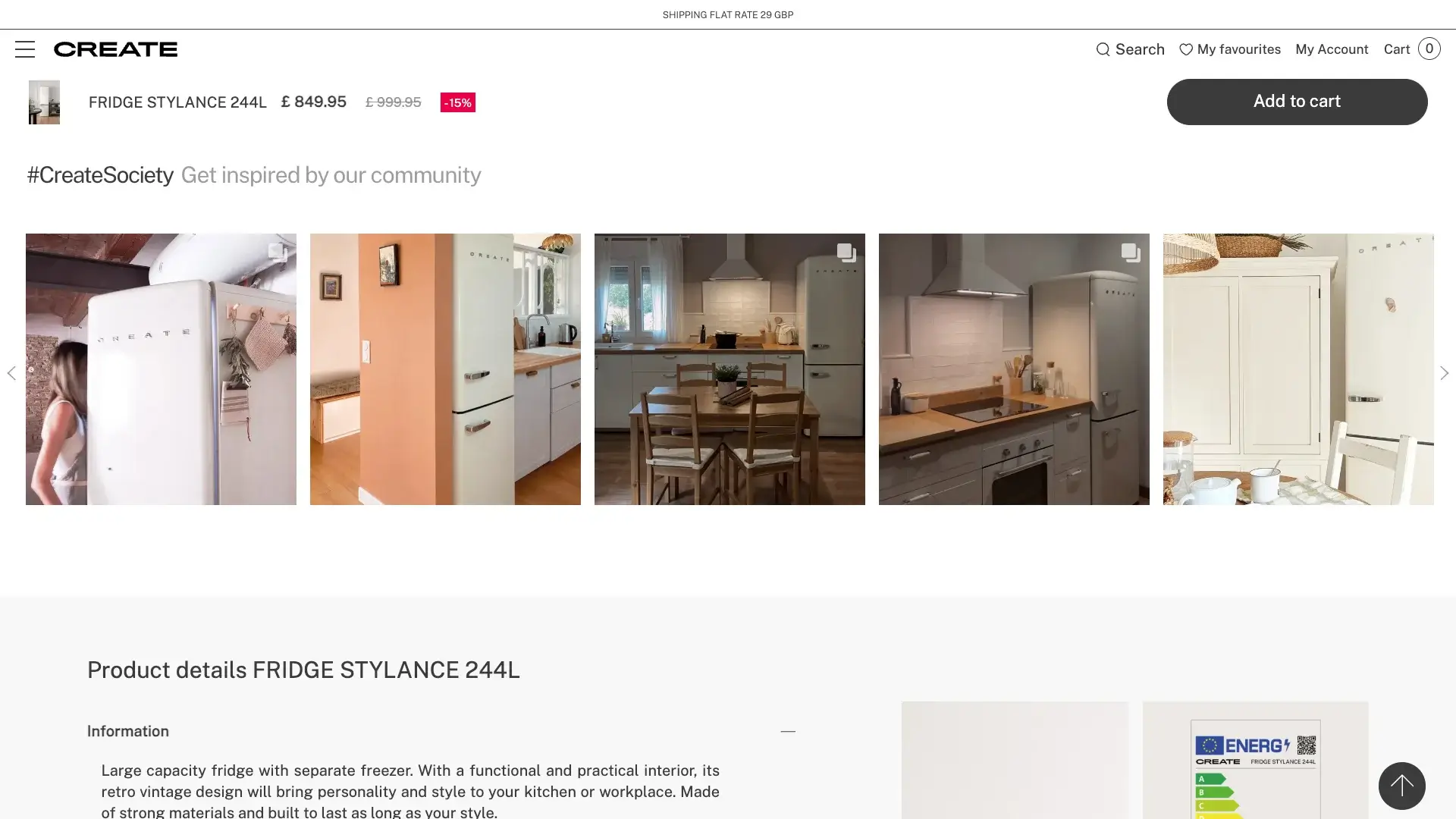
The home appliance brand CREATE shows the pace this reaches: over 350 UGC posts approved in six months, feeding product-linked galleries that drove a 10.7% CTR.
Influencer-generated content works the opposite way. Its volume is set in advance by campaign scope and budget, which makes deliverables easy to forecast but costly to scale across an entire catalogue.
Consumer-generated content costs little to acquire because customers produce it without involving the brand. The spend goes into incentives and community management rather than content production.
Influencer content is more expensive because it carries a clear reward per partnership, which can take the shape of cash, products, or discounts.
However, the real contrast is not between customer content and creator content; it is between both and the studio shoots they displace. Juliette Labarre, Brand Content Manager at the flooring retailer St Maclou, weighed the alternative directly:
“Before Flowbox, ‘more advertising-oriented’ ambiance shoots were done during major productions in homes or studios. Organising this requires time and substantial investment.”
Juliette Labarre, Brand Content Manager at St Maclou
Influencer content carries a clearer cost, a fee per partnership plus the overhead of managing it, yet it still comes in below a full professional production and buys predictability and cleared usage rights in one step. Its cost is also easier to justify than many teams assume, because a small test proves the model before any large commitment.
Either way, cost per asset only means something next to return. St Maclou attributes 13% of its sales to Flowbox-assisted journeys and sees a 10.5% click-through rate on its UGC, which reframes the content as high-efficiency rather than simply cheap.

Andrew Martin also acknowledged that one of the main difficulties for them was displaying content in a more authentic, reliable and cost-effective way to create a satisfying shopping experience for their customers.
“A main benefit of Flowbox UGC flows is that you can get a higher engagement rate than our staged photo shoots.”
Gary Evans, Chief Marketing Officer at Andrew Martin
Professional content in the furniture industry is quite expensive and problematic compared to the cost of managing user-generated content. Andrew Martin solved it by leveraging UGC, displaying authentic photos of their furniture in different homes.

On its own, consumer-generated content is not a reach play. Its native audience is whoever already follows the customer who posted it, which is rarely large. The reach comes from what a brand does next.
Redistributed through paid ads and on-site galleries, a single customer photo can reach the brand’s entire audience while keeping its peer-trust signal. Tom Meijer, Online Marketeer at XXL Nutrition, describes unlocking exactly that:
“We have a lot of followers on our social media accounts, but we never did anything with it. Now we can use the content made by our customers to our advantage. That’s very powerful.”
Tom Meijer, Online Marketeer at XXL Nutrition
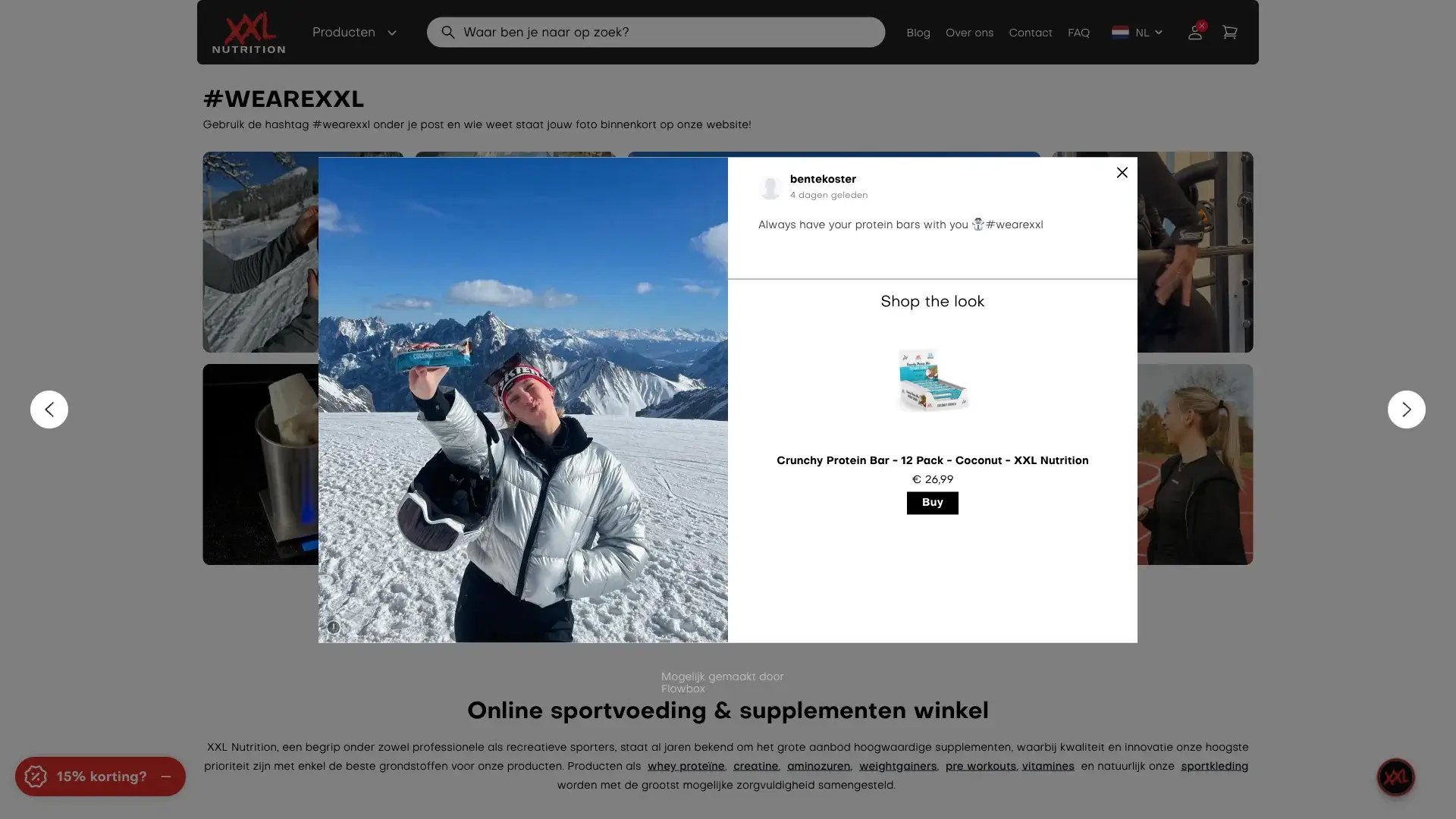
The supplements brand leveraged customer-generated photos to enrich its product catalogue, minimising the costs of expensive photoshoots.
On the other hand, influencer-generated content is built for reach from the start. You are effectively buying access to a defined audience. You can select creators by size and profile to enter a specific market. G-Star used this at the bottom of the funnel where the brand is less established:
“In The Netherlands and Germany, we have a lot of brand campaigns and G-Star is very well known, but in other countries like the UK and France, that bottom funnel DPA layer is the only thing we promote, which means that it’s often the first touch point that people have with G-Star.”
Bert Van Eetvelde, Paid Social Specialist at G-Star
The trade-off is ownership. Influencer reach is rented, so when a campaign ends, its reach ends with it. Customer content redistributed on channels the brand owns keeps working long after the moment it was captured, which is why the two are strongest when a brand funds reach with creators and compounds it with customers.
The two content types are controlled at different moments. Influencer-generated content gives the brand more upfront control, because a brief and an approval workflow shape the content before it goes live. Consumer content is spontaneous, so the control moves to the moderation stage: brands choose what to reuse rather than what gets shared.
For influencer-generated content, the danger is over-control, because if a brand dictates every detail, the content starts to look like the advert audiences have learned to skip. The stronger method is to select carefully and then hand over creative freedom, as Mar Escrivá, Head of Communication and PR at Sklum, explains:
“One of our priorities is to take care of the aesthetics and image of the brand, so when we partner with creators, we make sure their content aligns closely with our brand.”
Mar Escrivá, Head of Communication and PR at Sklum
Consumer content cannot be controlled at the point of creation, because a brand does not direct what its customers post. Control moves instead to curation, meaning you decide what to approve and where to place it.

Sklum applies that control unevenly on purpose using Flowbox tools, as Carmen Soria, Community Manager at Sklum, describes:
“The approval (moderation) tool is the one I use the most. Once I approve the content on the platform, I can make the request for media rights to the user in a simple way.”
Carmen Soria, Community Manager at Sklum
Consumer-generated content is the strongest tool for social proof, and it earns its keep where the purchase feels risky. For high-value, considered buys, seeing a real person’s result is often what lowers the perceived risk enough to commit. Katrina Bhowruth, Social and Content Manager at the sofa retailer ScS, explains the reasoning a shopper goes through:
“Buying a new sofa or piece of furniture for your home is an investment and decision-making can take a long time. You want to get the best value for your money and seeing the product recommended by someone else is proof of this.”
Katrina Bhowruth, Social and Content Manager at ScS
ScS found that shoppers who interact with UGC convert at 4.1 times the rate of those who do not, contributing to a 3.84% overall conversion rate increase.
At the furniture brand Jennifer Taylor Home, where a 49.7% conversion rate increase followed activation, Vu Tong explains why real settings matter for the category:
“Even though we list our products with the dimensions, some people can’t actually picture in their mind how big or small the item actually is. To see it in a real life setting, they actually get a better idea of what the product will look like.”
Vu Tong, eCommerce Account Manager at Jennifer Taylor Home
Influencer-generated content answers a different brief: awareness, launches, and reaching an audience a brand does not yet have. The accessories brand Misako leaned on creators to reach a new generation after rebranding, with eCommerce Manager Aleix Pi noting the goal was “to captivate this new generation and this new type of audience”.

Misako’s strategy resulted in a 7.17% engagement rate and a 7.97% click-through rate on the buy button in shoppable galleries, which redirected users to product pages.
This is why framing the choice as one type versus the other misleads. Influencer-generated content and consumer-generated content answer different questions, so the sharper move is to decide which objective you are serving and let the content type follow.
Placement decides performance more than most teams expect. Consumer-generated content performs best near conversion, on community, category, and product pages. Influencer-generated content performs best higher up, on social posts, ads, and the homepage, where awareness and consideration happen.
EVOC tested placements across its store and found customer content strongest at the point of decision. Maxi Ortmeier confirms it:
“The product page is currently the best performer. It’s at the bottom of the sales funnel, much closer to the purchase.”
Maxi Ortmeier, Senior Performance Marketing and E-Commerce Manager at EVOC
At that point in the journey, real-use content does two jobs: it settles hesitation, and it surfaces complementary products that lift basket size. The AOV effect shows up repeatedly across categories: XXL Nutrition recorded an 87.98% average order value uplift and Lampemesteren a 5.5% AOV increase alongside 44% more time on site for Flowbox-assisted orders.
“Maybe someone wants to buy a backpack and sees that someone also has the water bottle holder for it and says: ‘Okay, I’ll add that to the cart too’. So Flowbox is a really great upselling tool.”
Maxi Ortmeier, Senior Performance Marketing and E-Commerce Manager at EVOC
Influencer-generated content maps to the opposite end of the journey, on social posts, ads, and the homepage, where discovery and consideration happen.
G-Star’s creator-led ads act as a first touch in newer markets, warming up an audience long before it reaches a product page. Sequenced properly, influencer content earns the visit and customer content closes it at the point of sale. That handover, rather than a choice between the two, is what a full cross-channel UGC strategy is built on.
Neither consumer-generated nor influencer-generated content is inherently better. The right priority depends on where your brand is and what it needs to do next. A brand’s stage, budget, community size, engagement level, and market footprint all change which content type should lead and which should support.
So the useful question is not whether to choose consumer-generated content or influencer-generated content; it’s which one to prioritise for your current situation, and how much weight to give the other. The following sections map and explain the most common cases.
Once a community passes a certain size and stays engaged, it produces enough content to feed product pages, ads, email, and social without paying per asset. At that point, the marginal value of general influencer content declines.
The smarter allocation is to prioritise consumer-generated content and reserve influencers for moments that need a burst, such as new product launches, market expansion, or seasonal campaigns.
XXL Nutrition is a useful illustration. Its loyal customer base was already generating enough imagery to help populate a catalogue of over a thousand products, and activating that content contributed to an 87.98% average order value uplift on XXL Nutrition journeys.
A young community cannot yet supply the volume or the reach a brand needs. If this is the case for your brand, influencers should lead. They put the brand in front of relevant audiences quickly and generate the first wave of quality content while the customer base is still small.
The important move is to build the consumer-generated content foundation at the same time, as a long-term strategy. That foundation compounds. Every new customer is a potential contributor, so content that starts thin becomes self-sustaining as the community grows.
Culture does not translate cleanly, so local creators give a brand a relevance that a central team cannot manufacture, determined by the following base and localised posts.
Flowbox’s automatic collection feature and centralised content library build a consistent global trust layer and prevent brands from rebuilding collections from scratch in every market.
Across all scenarios, the conclusion is the same: the winning approach is not a single content type; it is the right mix of customer- and influencer-generated content. The proportions shift with a brand’s stage, budget, and goals, but both content types consistently perform best in combination, with influencer content opening the door and customer content closing the sale.
Prioritisation is really about sequence and weight, not exclusivity. A growing brand leans on creators today and on its community tomorrow. An established brand does the reverse and calls on creators when it launches. Treated as a single system within a single UGC management platform rather than as an either-or choice, the two content types cover the entire journey and continue to compound as the community grows.
The strongest strategies treat consumer- and influencer-generated content as two layers of a single system, not as rival tactics. Influencers create momentum and reach, while customers create the lasting proof that converts that attention into sales. Here is a practical way to combine them using Flowbox platform tools:
Because both content types live in the same platform, refining the balance between them is continuous rather than a periodic project. Each step feeds the next, and the mix keeps improving as your community and creator programme grow.
Ready to turn both your customer content and your influencer partnerships into your most powerful growth channel? Request a demo and join 1,000+ brands already scaling with Flowbox.