
Products
Case studies
Industries
Resources
I’m an Influencer
Influencer marketing has become one of the most reliable ways to build awareness and drive sales for a single reason: people trust recommendations from real voices far more than they trust advertising.
The appeal of influencer marketing to a brand is straightforward: they can reach a warm, relevant audience through someone they already listen to, and gain authentic content to reuse as social proof long after the campaign ends.
The challenge for brands is running influencer marketing at scale without losing that authenticity or having a dedicated department to handle collaborations, which is where a specially designed influencer marketing platform makes a difference in the numbers.
This guide is your starting point for influencer marketing. It covers what it is, its benefits for brands, where it works, and how to build, measure, and resource a long-term influencer programme.
Influencer marketing is the practice of partnering with trusted social media creators to promote a brand’s products to the audiences who already follow them. A brand teams up with creators who have loyal audiences and recommends the brand or its products to their followers, generating reach, brand awareness, and ultimately conversions.
This approach works when followers trust the creators and value their opinions, especially when they have been following them for a while. When a creator recommends a product, a place, or a brand, it has a bigger impact than a brand alone usually can achieve. That trust and social proof encourage people to buy.
The scale is significant. According to the Influencer Marketing Forecast 2026 by Influencer Strategist and NeoReach, nearly 75% of Gen Z and Millennial consumers follow influencers specifically for product recommendations, and 25% of consumers report buying a product based on a creator’s recommendation.
Check Flowbox’s report, the State of Micro-influencer Marketing in Europe 2026, for more details on the topic.
There are many ways of doing influencer marketing, with seasonal or always-on campaigns, collaborations with nano or macro-influencers, launching a brand ambassador programme, and choosing between Instagram, TikTok, YouTube, etc.
No matter the options, a typical collaboration between a brand and an influencer follows a clear path:
The strongest influencer marketing programmes treat this as an ongoing relationship rather than a one-time transaction.
On the Flowbox platform, 81% of brand-influencer collaborations are repeat partnerships across multiple campaigns rather than single engagements, which shows how much value sits in building a lasting creator community.
Here you can check some real collaborations between brands and influencers, via the Flowbox platform, from different locations and languages:
The difference between Influencer-Generated vs Customer-Generated Marketing is simple: if the brand paid for the content, briefed the creator, and agreed on terms, it’s influencer marketing; if the content is generated organically because the creator is satisfied with the brand, it’s consumer-generated marketing.
These terms overlap because the satisfied customer might be an influencer giving a genuine recommendation to their followers. However, if the brand didn’t pay for the content, it’s considered customer-generated content. These terms also generate confusion when they overlap with UGC creators marketing.
UGC creators aren’t necessarily influencers; they’re more like professional content creators brands can outsource to generate UGC. A creator may have a smaller following but a strong ability to produce content that resonates within a niche. Understanding the difference between a UGC creator and an influencer helps you brief each type correctly and pay for the right thing.
Customer-generated marketing then corresponds to the strategy behind collecting, moderating and distributing photos, videos and reviews generated by your customers, organically and without the brand’s approval or participation. It is worth being precise about the distinctions, because consumer-generated content and influencer-generated content play different roles in a content strategy.
And finally, user-generated content, commonly known as UGC, is the broadest term, covering any authentic content real people create around a brand, including influencers, UGC creators, and customers. Influencer marketing is one input into your overall UGC approach, not a separate silo.
Influencer marketing works for eCommerce and consumer brands because it borrows trust and channels it toward a purchase. Buyers filter out advertising, but they lean in when someone they follow shows a product in a real-world context.
Trust is the foundation. According to Nielsen’s 2021 Trust in Advertising Study, 88% of global respondents trust recommendations from people they know more than any other channel. Smaller creators punch above their weight. Clutch’s survey shows that 55% of Gen Z consumers say they trust influencer recommendations. Authenticity, not follower count, is doing the heavy lifting.
Beyond trust, influencer marketing delivers benefits a marketing team can plan a campaign around. Each one solves a distinct problem along the path to purchase:
Explore the main benefits of influencer marketing for brands, backed by data, if you want to know more about the topic.
Influencer marketing varies depending on the type of creator you work with and the format of the collaboration and content. Choosing well depends on your goals, your budget, and your relationship with the creator.
There isn’t one single way to sort influencer marketing, and the useful frameworks answer different questions.
A campaign usually combines all three at once, so it helps to treat them as separate decisions rather than one. The type of influencer marketing you’ll do depends on those decisions.
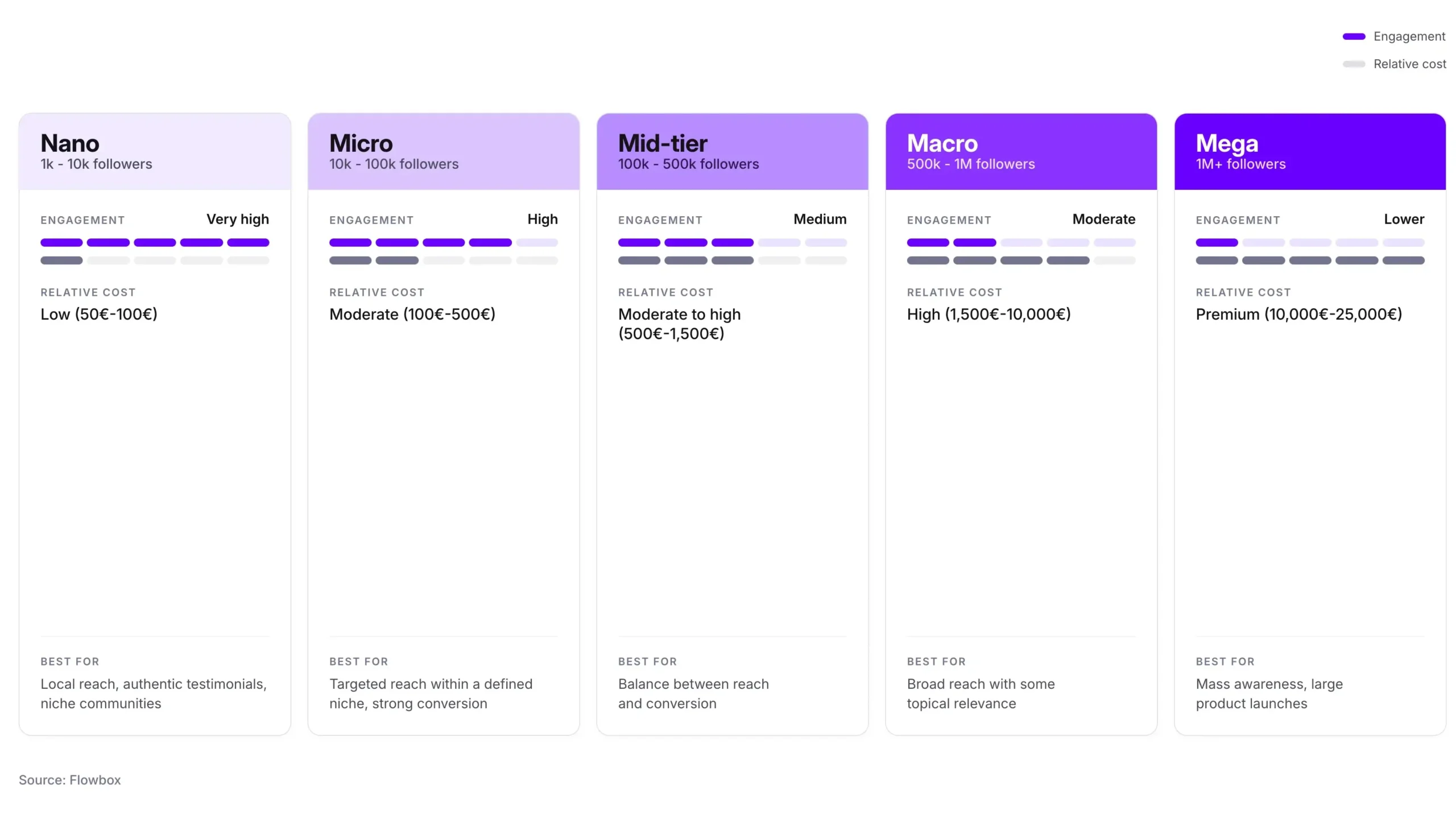
Influencers are usually grouped into tiers by follower count, and each tier trades reach against engagement and cost. The table maps five influencer tiers by audience size, showing how cost and engagement shift as follower counts grow.
| Tier name | Follower range | Engagement | Relative cost | Best for |
| Nano | 1k – 10k | Very high | Low (50€-100€) | Local reach, authentic testimonials, niche communities |
| Micro | 10k – 100k | High | Moderate (100€-500€) | Targeted reach within a defined niche, strong conversion |
| Mid-tier | 100k – 500k | Medium | Moderate to high (500€-1,500€) | Balance between reach and conversion |
| Macro | 500k – 1M | Moderate | High (1,500€-10,000€) | Broad reach with some topical relevance |
| Mega | 1M+ | Lower | Premium (10,000€-25,000€) | Mass awareness, large product launches |
Nano-influencers usually have the smallest but most engaged audiences and the lowest cost, making them ideal for local reach and authentic testimonials. Micro-influencers tend to keep engagement high at a moderate cost, suited to targeted, conversion-focused campaigns.
Starting at mid-tier creators, you can see a balance in reach and conversion. Macro-influencers, by contrast, offer broad reach with moderate engagement at a higher cost, given their large following. Mega-influencers deliver the widest reach but the lowest engagement, at a premium cost, making them the best option for mass awareness and major launches.
The table shows a clear pattern: engagement falls as reach and cost rise, so the right tier depends on whether the goal is engagement and conversion or reach and awareness.
The instinct to chase the largest audience is often the wrong one, because the smaller tiers tend to deliver stronger trust and better value for money. The clearest trend is a shift toward smaller creators.
That trust gap is measurable. UGC and micro-influencers are 9.8x more trustworthy to consumers than macro-influencers and celebrities, making them the perfect solution for brands seeking fresh, authentic content. In 2025, 93% of marketing teams rating their efforts as “effective” increased their investment in micro-influencer marketing and UGC.
Once you know which tier fits for each goal, you choose how to work together. The most common collaboration types sit on a spectrum from lightweight to deeply integrated:
Ambassador programmes compound over time, because a creator who genuinely uses your products makes more authentic content the longer the relationship runs. This format deserves its own playbook, which you will find in the guide to brand ambassadors.
A useful way to read this list is by cadence. Gifting, sponsored content, and giveaways are usually run as one-off campaigns, tied to a specific moment like a launch or a seasonal push, with a clear start and end. Ambassador programmes, and often affiliate deals, are always-on: they run continuously and are built to compound.
One-off campaigns are quicker to set up and easier to measure in isolation, while always-on relationships cost more to maintain but tend to produce more authentic content and steadier results the longer they run.
Most brands use a mix, with a few always-on partners as a base and one-off activations layered on around key dates.
The collaboration type sets the terms of the deal; the content delivery format decides what the creator actually makes and which platform it lives on.
The same partnership can produce very different results depending on whether it results in a quick vertical video, a static image, or a long tutorial, and whether it’s sent to the brand directly or posted on the creator’s account.
Here are some of the most common influencer marketing content delivery formats:
Instagram gives creators three main formats, each with a different job in terms of reach, lifespan, and engagement.
Reels are short-form vertical video and Instagram’s most discoverable format, surfaced to people who don’t already follow the creator, which makes them well suited to introducing a product to a new audience.
In-feed posts, whether single image or carousel, are the more permanent format that stays on the profile and works well for detailed product shots or step-by-step carousels.
Stories are full-screen and disappear after 24 hours, which suits time-sensitive content like launches, discount codes, or link stickers that send traffic straight to a product page.
On TikTok, short-form video is the core format and the main driver of the platform’s discovery-led reach, where content is served primarily on interest rather than follower count. This is what lets smaller creators reach large audiences when a video performs well.
Photo posts sit in the same discovery-led feed as video. They’re a useful lighter-lift deliverable for product close-ups, before-and-afters, or text-led storytelling, and because they’re surfaced by the same interest-based recommendation system, a strong carousel can reach well beyond a creator’s follower count in the way a video can.
TikTok also offers Stories, a full-screen disappearing format similar to Instagram’s, though it’s a lighter, more secondary option useful for behind-the-scenes clips or quick follow-ups rather than a campaign’s main deliverable.
YouTube spans two very different formats. Shorts are vertical, short-form videos built for quick discovery, comparable in spirit to Reels and TikTok videos.
Long-form horizontal video is where YouTube stands apart: in-depth reviews, tutorials, hauls, and unboxings give creators room to demonstrate a product properly and build genuine trust.
This depth suits considered purchases and higher-value products, and because YouTube doubles as a search engine, these videos can keep pulling in views and driving traffic long after they’re published.
Not every collaboration ends with the creator posting on their own channels. UGC creators produce the content and deliver it directly to the brand, which then owns and publishes it. It never appears on the creator’s own feed.
This content delivery format suits brands that want a reliable supply of authentic visuals for product pages, paid ads, or email galleries, without depending on a creator’s audience size or posting schedule.
Because the brand decides where and how long the content runs, a single shoot can be repurposed across several channels, and usage rights are agreed up front rather than chased after a post has already gone live.
Now that you understand the concept, let’s explore real influencer marketing examples from leading brands using Flowbox’s platform to manage theirs.
The brands below run different campaigns and strategies, from building an ambassador roster, keeping a steady stream of content flowing month to month, timing a push around a season, or launching a new collection. Here’s how they do it:
Every month, Rabatta asks their influencer team to share their thoughts and experiences about the brand on their own social media channels.
This consistent and flexible approach to influencer marketing allows Rabatta to stay top-of-mind with their target audience and create a variety of content pieces that resonate with different segments of their market.
As part of this strategy, Rabatta takes advantage of TikTok’s powerful advertising capabilities by boosting all influencer content through Spark Ads, significantly increasing organic reach via paid promotion.
As explained in Rabatta’s case study, the brand successfully reached over 1.8 million people with a single campaign in just one country. The beauty of Rabatta’s campaign lies in its flexibility. The campaign brief is intentionally open-ended, allowing influencers the freedom to create content that aligns with their unique voice and brand values.
As the warm weather and summer holidays approached, it was the perfect time for Peter Larsen Kaffe to highlight their popular iced coffee, available in three distinct flavors.
To execute the campaign, Peter Larsen Kaffe invited 38 influencers to try their iced coffee flavors in exchange for content and exposure through their Instagram profiles.
By working with a diverse group of influencers, the brand ensured that the campaign reached various segments of their target audience, each with unique preferences and lifestyle habits.
The influencers were given the freedom to share their personal experiences with each of the three iced coffee flavors, allowing their audiences to see the product in real-life scenarios. This created a sense of trust and connection, positioning Peter Larsen Kaffe as a must-have item for summer.
“The collaboration with Flowbox has been a key part of our summer campaign for iced coffee, where together we’ve managed to create strong awareness of our iced coffee within the target audience in an easy and effective way.”
Josefine Kaagaard, Brand Campaign Manager at Peter Larsen Kaffe
The “Adventurous Collection – SS24” campaign was designed to showcase A.KJÆRBEDE‘s latest Spring/Summer 2024 sunglasses collection. A key goal was to create a wave of authentic, high-quality content that would resonate with A.KJÆRBEDE’s target audience.
To achieve this, the brand partnered with influencers via Flowbox’s influencer marketing platform, which streamlined communication and collaboration with micro-influencers across social media.
The influencers were encouraged to showcase how they styled the new sunglasses in real-life, adventurous settings—whether it was on the streets, at a café, or in the park—capturing the essence of the collection’s spirit. Read the A.KJÆRBEDE case study to learn more.
Once the content was live, the influencers generated Spark Ads codes, allowing A.KJÆRBEDE to amplify the reach of the videos through paid promotion. The results spoke volumes: the campaign not only boosted brand visibility but also led to increased engagement, ultimately surpassing initial performance goals.
Brand ambassador programmes involve partnering with creators on an ongoing basis rather than through one-off posts. Ambassadors often form a long-term relationship with the brand, consistently creating content, sharing updates and embedding the brand into their everyday lifestyle.
Some brands are taking ambassador programmes to the next level: Skoringen has a dedicated ambassador page where each ambassador is spotlighted with their own page featuring favourite products in a shoppable gallery. This strategy shows a more human, intimate approach, and leverages the creators’ relationship with the brand.
An influencer marketing strategy puts intention behind every collaboration. Rather than posting reactively or picking creators on aesthetics alone, it forces you to be clear about why you’re partnering with someone and what the collaboration is meant to achieve.
Here are the key steps to help you build an effective influencer marketing strategy:
If you are interested in diving deep into each step, read our article on influencer marketing strategies and how to build your own.
The table below lists influencer marketing strategies by their strategic objective, the campaign formats each one typically uses, and the KPIs that matter most to online retailers.
| Type of influencer marketing strategy | Goal | Typical campaign formats | Primary KPIs |
| Full-funnel strategy | Drive awareness through to purchase within the same ecosystem | Awareness posts, product demos, reviews, affiliate content, paid amplification | Reach, traffic, assisted conversions, conversion rate |
| Brand-building strategy | Build brand salience and preference in competitive categories | Long-term creator partnerships, lifestyle storytelling, seasonal campaigns | Reach, frequency, brand lift, branded search growth |
| Performance-led strategy | Generate direct revenue and measurable ROI. Produce high-performing assets for sales, paid ads and on-site use. | Affiliate links, discount codes, shoppable posts. Creator UGC for paid social, PDPs, homepage galleries, and email. | Sales, ROAS, CPA, revenue per creator CTR, CPC, conversion rate uplift |
| Localisation and market-entry strategy | Drive adoption and conversion in new markets | Local creators, language-specific content, regional launches | Traffic by market, conversion rate, and AOV by region |
| Advocacy and loyalty strategy | Increase repeat purchases and lifetime value | Brand ambassador content, repeat endorsements | Repeat exposure, retention rate, LTV uplift |
As the table shows, each strategy pursues a different objective, and each ties back to commercial metrics such as traffic quality, conversion rate, average order value, and customer retention. Match a strategy to both your marketing goals and your commercial priorities to get the most out of your influencer collaborations.
According to The Drum research, influencer marketing strategies often fail because they are treated as an unstructured add-on, with creators chosen at random, given unchecked creative freedom, and disconnected from wider brand activity, despite this going against proven creative effectiveness principles.
To deliver real impact, marketers must lead the strategy, integrate creators into a clear brand and creative platform, and hold their output to the same standards as any other channel. When creators are treated as a core brand-building channel rather than a shortcut, influencer marketing becomes more consistent, distinctive, and effective at driving long-term growth.
A separate but not isolated part of your influencer marketing strategy is activating your community to generate more content, which could look like this: You partner with a macro-influencer first to generate reach and put your brand in front of a large audience.
That visibility does more than build awareness with customers. It also gets you noticed by smaller creators, who see the association and become willing to create content of their own, often in exchange for a discount or a modest payment rather than a full fee.
The result is a cost-effective content engine. Instead of paying premium rates for every piece, you use one larger partnership to seed interest, then let smaller creators and customers supply a steadier stream of authentic content at a fraction of the cost.
Each creator who posts about your brand is a recommendation reaching a new audience, so the more creators you bring in, the wider that purchasing signal spreads.
This section is for general information only and is not legal advice. Regulations differ by country and change over time. Confirm your obligations with a qualified legal professional before running a campaign.
Influencer marketing sits on top of several bodies of law at once: advertising rules, data protection, tax reporting, and copyright.
Getting the creative right is only half the job. The other half is making sure each collaboration is disclosed properly, that you have the legal right to use the content you pay for, and that the terms are written down. This section covers the three areas that trip brands up most often.
Any content a creator is paid or incentivised to produce counts as advertising, and it has to be identifiable as such to the audience. That’s the core principle across most major markets, even though the exact wording and enforcement differ by country.
In the EU, disclosure obligations come from a set of horizontal rules, chiefly the Unfair Commercial Practices Directive (Directive 2005/29/EC). Under it, an influencer acting for a brand is treated as a “trader” and must make their commercial intent clear. Failing to disclose that intent is a misleading omission under Article 7(2), and Annex I point 11 specifically bans presenting paid-for editorial content as though it were independent, without making the payment clear.
Any incentive triggers this, including payment, a discount, affiliate commission, or an unsolicited free product, and the European Commission’s guidance is that liability can fall on both the influencer and the brand that engaged them. These rules are reinforced by the Audiovisual Media Services Directive and the Digital Services Act, and some member states have added their own national influencer laws on top.
The practical point is the same across all: disclosure is the brand’s responsibility too, so labelling requirements belong in the brief and the contract. The European Commission has launched an Influencer Legal Hub to help influencers, brands, and agencies navigate the evolving landscape of influencer marketing regulation in Europe.
To facilitate collaborations between brands and influencers, we make it clear in section 4.2 Campaign obligations of Flowbox’s Influencer Terms & Conditions: ‘On the influencer’s post, it must be clearly stated that it is advertisement’. This means every influencer you collaborate with on our platform has accepted that obligation.
If your campaign processes the personal data of people in the EU or the EEA, the General Data Protection Regulation (Regulation (EU) 2016/679) applies. It also reaches brands outside the EU that target or monitor people inside it, so a non-EU brand running EU campaigns is still caught. Each member state has a national supervisory authority that enforces it.
For influencer marketing, personal data appears in more places than brands expect: creator contact details, audience data shared during reporting, and any user-generated content featuring identifiable people.
Flowbox platforms are built to process content and data in line with the GDPR and let you locate all data traceable to an individual so you can action data subject requests. It also asks you to link your own privacy or terms page in rights request templates. On the influencer side, the platform’s privacy policy assigns a specific lawful basis to each processing activity under GDPR Article 6.
In the EU, platforms that pay creators may fall under DAC7 (EU Directive 2021/514), which requires digital platform operators to collect and report the income of reportable sellers to EU tax authorities, in force since 1 January 2023. The point that matters most for brands: the reporting obligation sits with the platform operator that facilitates the activity, not with the individual brand.
It reaches platforms based outside the EU where they facilitate relevant activities of EU-resident sellers, and creator work can fall under its “personal services” category. There are exclusions and thresholds, though the commonly cited de minimis of fewer than 30 transactions and under 2,000 euros applies specifically to the sale of goods, so it should not be assumed to exempt creator income.
Flowbox’s influencer marketing platform handles this at the platform level. As an EU platform operator, Flowbox collects, verifies, and reports the income creators earn through it as required under DAC7; so when you pay creators via the platform, that reporting layer sits with the platform rather than falling on your brand.
Paying a creator to make content does not automatically give you the right to use it wherever you like. In the EU, the European Commission is explicit that copyright is generally owned by the natural person who creates the work, and in most member states the author is the first owner.
Economic rights can be transferred or licensed by contract, but moral rights generally cannot be transferred, and in many continental systems cannot be waived. First ownership of commissioned work is set by national law rather than fully harmonised across the EU, so the exact default varies by country. Either way, a brand receives only the usage rights it has explicitly been granted.
A licence typically defines where the content can appear, for how long, and whether it can be edited or used in paid ads.
Reposting a creator’s organic post to your product page or running it as an advert without a licence is a common and avoidable mistake, and securing rights up front is what lets a brand repurpose creator content across product pages, ads, and email with confidence.
This is where Flowbox does real work:
Learn more about influencer content licensing and how to manage agreements to avoid legal issues in your collaborations.
A contract turns everything above into something enforceable across every market. Rather than relying on DM agreements, a written contract records what each side has committed to.
At a minimum, a creator contract usually covers the deliverables and deadlines, the fee and payment terms, the usage rights and licence duration, the disclosure requirements, and any exclusivity or competitor restrictions. Because ownership, disclosure, and data rules differ between markets and regions, a contract is also where you set the governing law and make sure the same collaboration is compliant in each market it runs in.
The size of the deal does not change the principle, since disputes over who can use what content, and for how long, happen just as easily with small creators as with large ones.
Flowbox does not generate contracts or provide contract templates, but the rights-grant status and consent records it stores give you a documented trail of who granted what and when. That supports a written contract as an audit trail, without replacing it.
For campaigns, Flowbox’s influencer marketing platform gives you a baseline contractual framework so you are not relying on DM agreements. Its creator terms, accepted at signup and per campaign, set the relationship as an independent-contractor one with no employment status, fix the default content, disclosure and usage obligations described above, and set out what happens if a creator does not deliver, including the brand’s right to withhold payment or reclaim the value of gifted product.
The campaign briefing step is where you attach the specific terms to each collaboration, not covered by the general terms and conditions. Within a campaign, you set the brief and content guidelines, the hashtags to track, and the deadline creators post against, so the deliverables and timing are recorded in the platform rather than agreed loosely over DM.
On payment, you can set a fixed fee and pay creators directly through the built-in payment system, run dynamic pricing that ties the fee to performance, or compensate with gifted products and vouchers. If you connect Shopify or WooCommerce, you can also issue audience discount codes for creators to share with their followers. For creator payments in the EU, the platform supports DAC7 tax-reporting compliance.
Influencer-generated content resulting from a brand’s influencer marketing is expensive to produce and quick to disappear. Reels and posts peak in their first days, then the algorithm buries it. The same thing happens with Stories: they last 24 hours before disappearing completely.
The collaboration fee stays the same whether that content works for two days or two years, so your return depends almost entirely on how many places you put it once the original post goes live.
Repurposing is what closes that gap. Moving creator content into your channels turns a post with a 24-hour shelf life into an asset that keeps working.
Here is where to repurpose influencer-generated content:
Your website is the highest-value destination because visitors arrive with intent. They are comparing and deciding, not scrolling, so creator content has room to do its job instead of fighting a million other posts for attention.
A gallery on the homepage sets the tone the moment someone lands, showing real people using your product alongside studio shots. Here is an example from Rowico Home’s homepage:
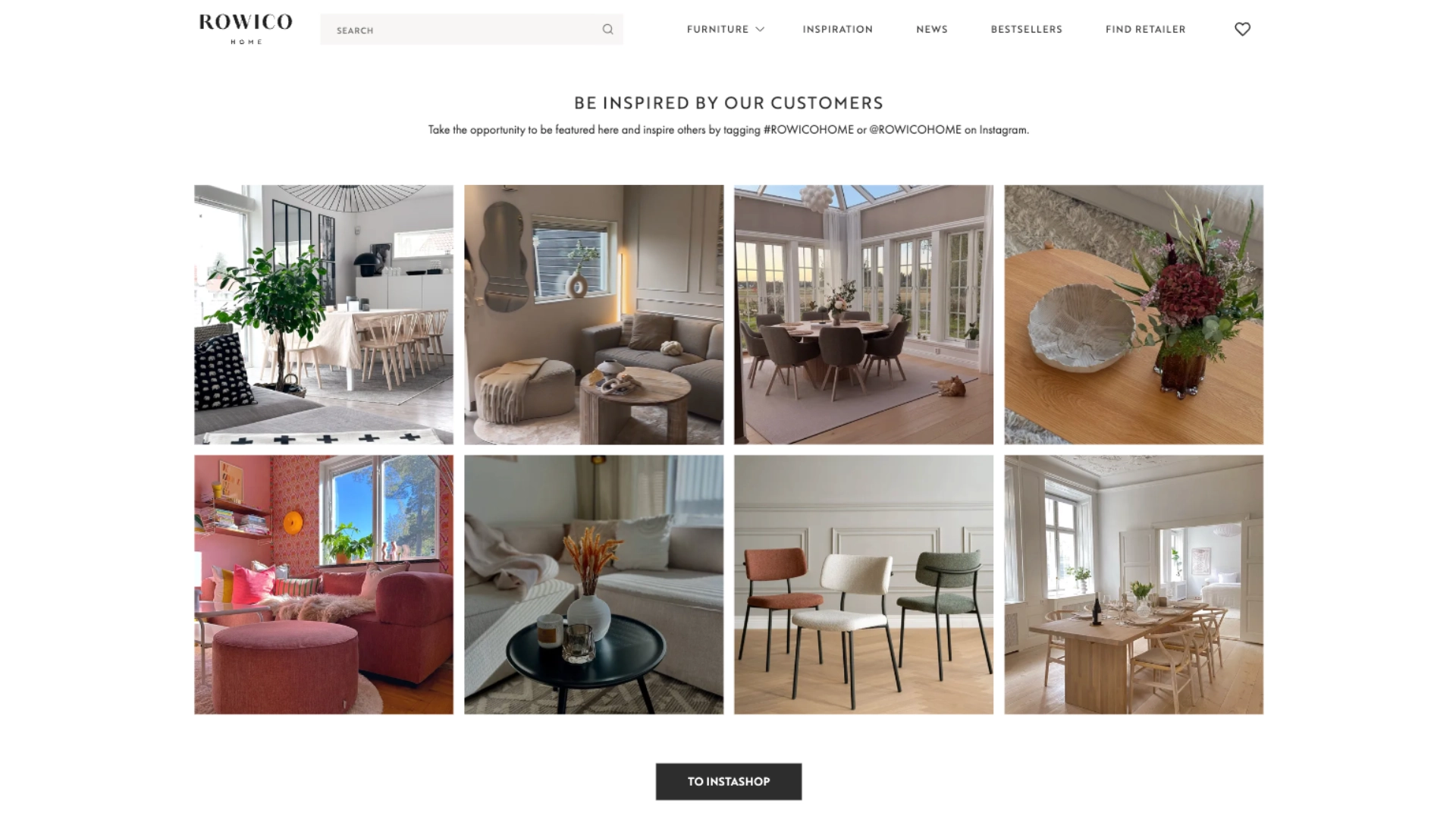
Rowico Home’s case study shows how the brand moved community and creator images onto its site, and measured a 52% uplift in average order size and a 67% uplift in average order value.
“We have UGC on different landing pages like product, category, homepage, and on our Insta Shop page. We also have UGC on our 404 page and in other locations, such as our bestseller page. They can find UGC on the whole website. Throughout the shopping journey, they will be able to see other customers’ homes. We have also moved UGC into our email communications and on our own Instagram feed, having it also show up in our stories as ‘Moments from You’.”
Linnéa Sollin, E-commerce Coordinator at Rowico Home
This is usually where IGC converts hardest, because a creator’s photo sits next to the product exactly when the buyer is deciding. Here is an example from Jennifer Taylor Home’s product page:
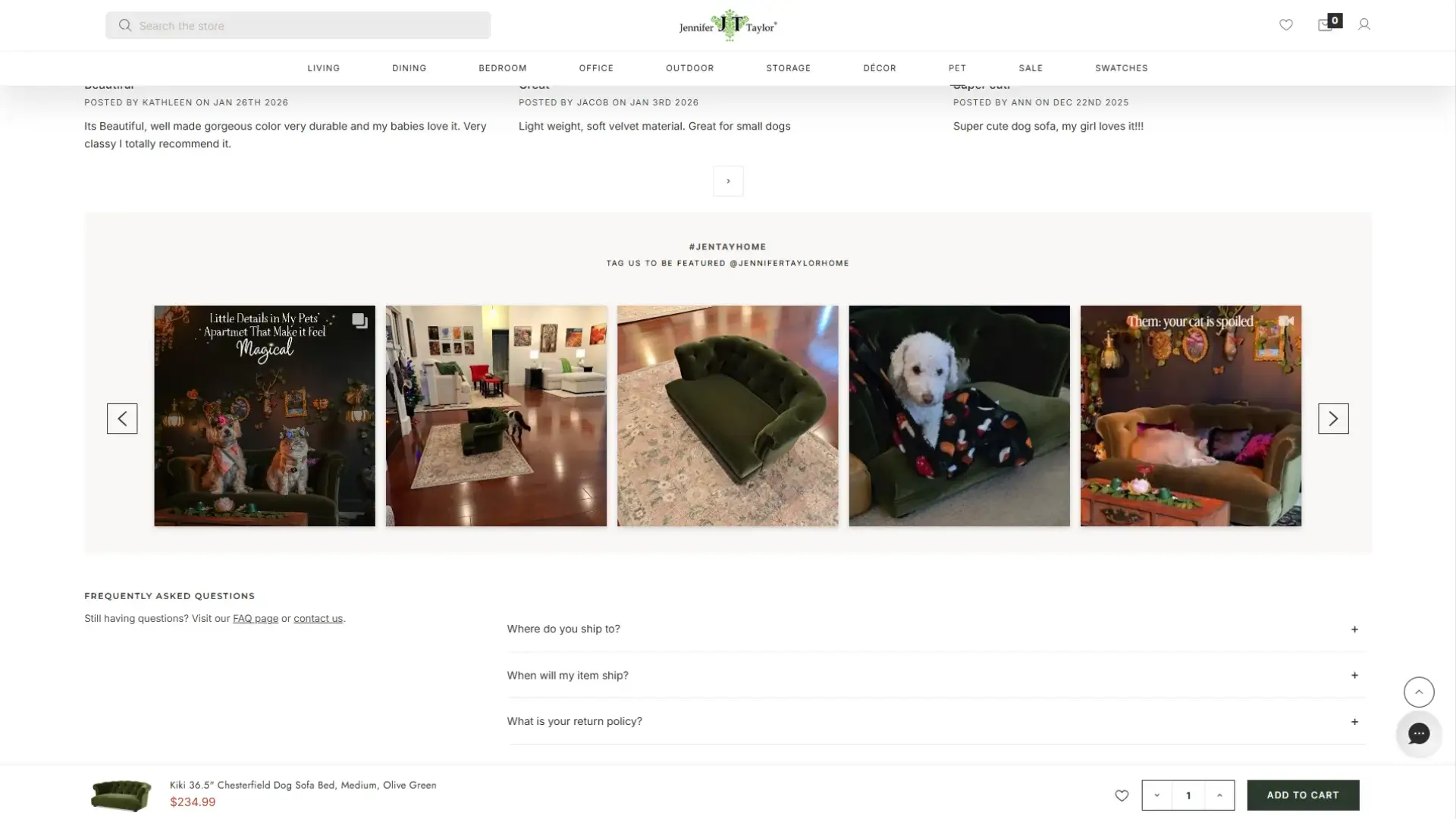
Jennifer Taylor Home added customer and creator imagery to its product listings and saw a 49.7% increase in overall conversion rate, with 22.06% of visitors interacting with the content. Read the Jennifer Taylor Home case study to learn more.
“Even though we list our products with the dimensions, some people can’t actually picture in their mind how big or small the item actually is. To see it in a real life setting, they actually get a better idea of what the product will look like in terms of size and everything else.”
Vu Tong – eCommerce Account Manager at JTH
Community and inspiration pages
A dedicated community page is the natural home for your fuller creator library, and it doubles as inspiration for browsers. Here is an example from Tuinmeubelshop’s inspiration page:
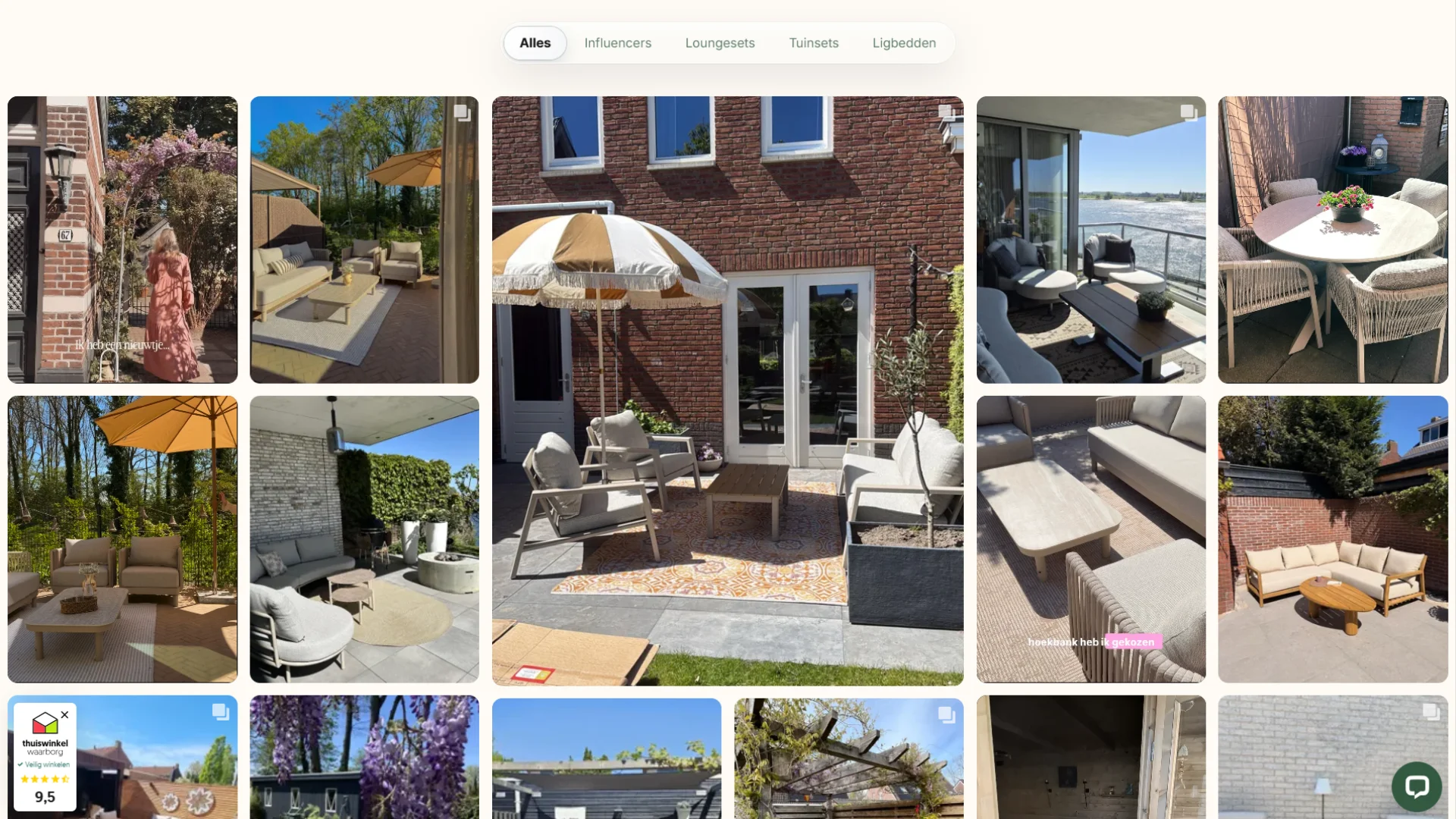
Tuinmeubelshop reported a 17% conversion increase on pages with Flowbox widgets and that visitors who interact with the content stick around 28% longer.
“We also created our community page last month, and now most of the interest comes from there. New visitors land on the webshop, go to the community page, and they’re really inspired by it.”
Gerrit van der Garde, Director of Marketing at Tuinmeubelshop
Email is one of the highest-ROI channels you own, and creator content makes it read less like a broadcast. Embed IGC in newsletters, abandoned-cart emails, and post-purchase flows, where a real image of the product can nudge a hesitant buyer over the line and satisfied customers can be encouraged to share testimonials.
Flowbox’s Email Assets automatically pull approved content into campaigns, so visuals stay fresh without manual swaps. VVV Zuid-Limburg saw around 8% of newsletter openers click the Flowbox element after adding it to their emails.
Creator content often beats polished brand assets in paid media, because it looks native to the feed. IGC can feed dynamic product ads so your catalogue connects to real usage rather than pack shots.
Kids Brand Store saw a 26% increase in return on ad spend when using Flowbox DPA tools. Read the full case study on the Kids Brand Store.
Repurposing does not have to stay digital. Creator content works on in-store screens, printed lookbooks, event displays, and packaging inserts, giving a collaboration a second life in physical space. TrainMore, for instance, runs member and creator content on gym screens to build a sense of belonging on site.
Influencer marketing’s impact shows up in two places: the reach and trust it builds early in the funnel, and the tracked sales and reusable content it delivers further down.
It works because of trust, authenticity, and credibility. Shoppers act on recommendations from people they follow, and smaller creators tend to hold the most engaged audiences.
As presented in the State of Micro-Influencer Marketing in Europe 2026:
The results brands see bear this out. When JBL launched the PartyBox Club 120, it ran a microinfluencer campaign aimed at Gen Z, letting creators shoot their own party-focused videos instead of following a rigid brief. The outcome: 8 influencers produced 28 pieces of content on Instagram, generating 332k in reach, 240 saves, and 160 shares. Read the JBL case study to learn more.
Beyond one-off campaigns, brands like Rabatta ask their influencer team every month to share their thoughts and experiences about the brand on their own social media channels. Rabatta leverages TikTok’s advertising capabilities by boosting influencer content through Spark Ads, significantly increasing organic reach through paid promotion and allowing it to reach over 1.8 million people with a single campaign in one country, 16k interactions and 240 shares. Read the Rabatta case study.
“With this campaign, we have received varied, high-quality content from creators, which has delivered strong results both organically and as part of our advertising. One of the advantages of Flowbox is that the creators on our team can work from the same campaign brief and still deliver such diverse content that appeals to different audiences, highlighting the benefits of downloading our app.”
Rasmus Hansen, CMO & Co-Founder
The same pattern holds across the wider set of Flowbox customers using influencer content:
Check our case study page to learn more about brands’ results with Flowbox.
These brands are clearly achieving noteworthy results with influencer marketing, so the remaining question is: how can you measure yours?
The metrics below are grouped by what they tell you, moving from awareness at the top of the funnel down to return on spend. Engagement is the early signal, and conversion and order value are where the return lands.
Flowbox captures these metrics in one place and connects creator activity to business outcomes. The metrics above reach you in three ways.
Reach, impressions and views, likes, comments, saves, shares, engagement rate, and campaign traffic from socials through UTM link tracking. Creator quality is scored with the Impact Score, content volume is tracked automatically in the Content Library, and repeat collaboration is visible through campaign and team history. As a benchmark, 81% of collaborations on the platform are repeat rather than one-off.
Attributable orders and revenue at the creator level. Audience Discount codes tie individual orders to individual creators, and with WooCommerce or Shopify connected, those sales, along with average order value, are read against each campaign.
When influencer content is placed in a shoppable gallery on your site, the analytics suite measures its on-site performance for you. That includes CTA click-through rate on ‘view product’ buttons connected to product pages, the conversion rate of shoppers who interact with the content, and the sales uplift against shoppers who do not. Performance is broken down per widget, per post, and per product, so you can see which content actually drives revenue.
Calculated by you, on Flowbox inputs
ROI, earned media value, and cost per result. Flowbox holds the cost side through built-in payments and vouchers, and the performance side through reach, engagement, on-site conversion, and attribution, which gives you every input these calculations need.
An influencer marketing platform is software that helps brands plan, run and measure their influencer marketing campaigns.
Most platforms offer businesses marketplaces of creators and influencers, plus tools for outreach, briefs, contracts, payment handling, and analytics that tie activity to performance and results.
Here are the top 3 influencer marketing platforms that stand out for making the influencer collaboration process smoother and more effective. If you want to explore more platforms or check the following ones in detail, read our full article on the Top 10 Influencer Marketing Platforms.
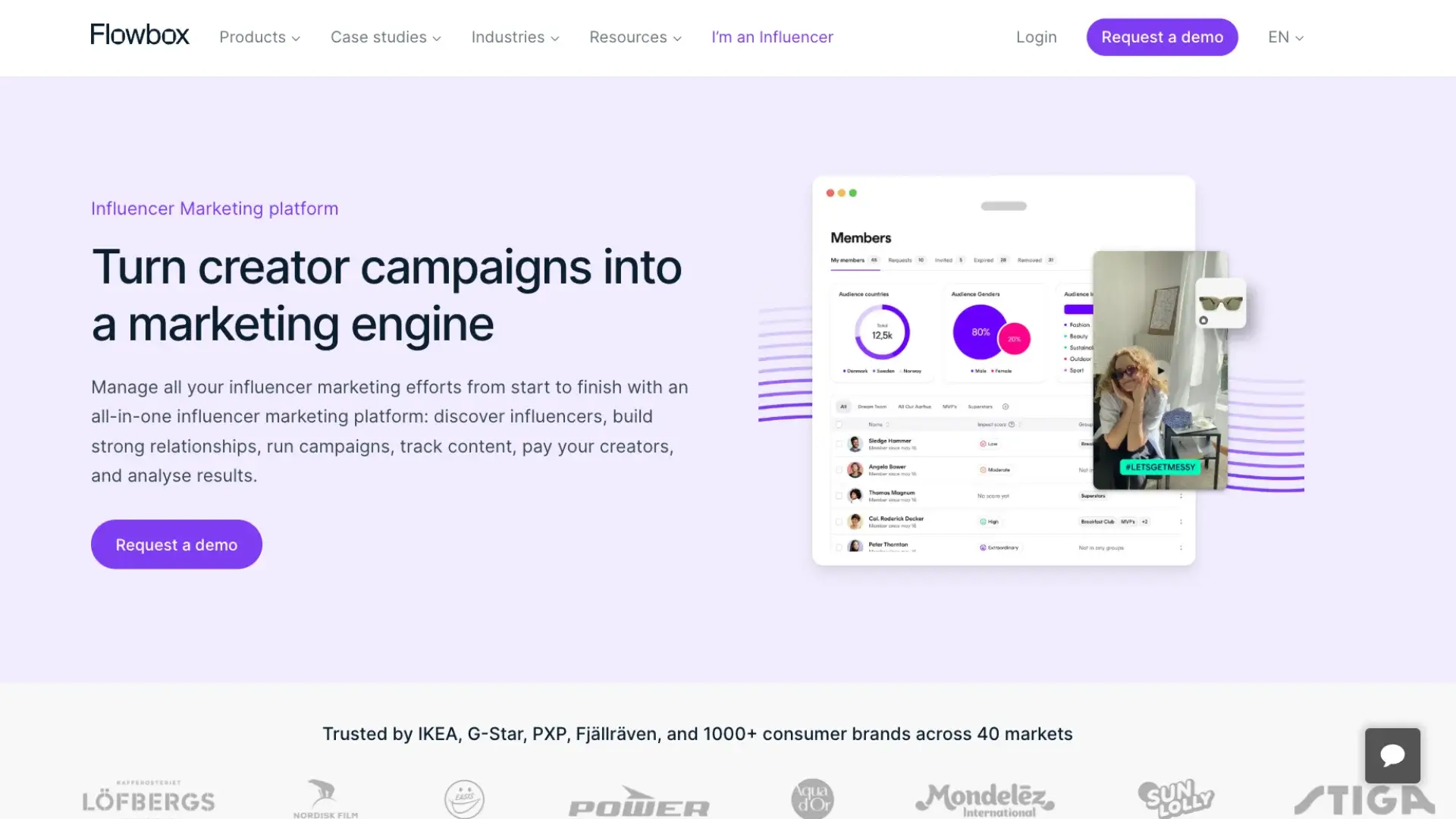
Flowbox’s influencer marketing platform helps brands manage every stage of their influencer collaborations, from discovery and briefing to reporting and payments. Flowbox combines influencer management with first-party data and UGC capabilities, creating one connected space for brand-creator partnerships.
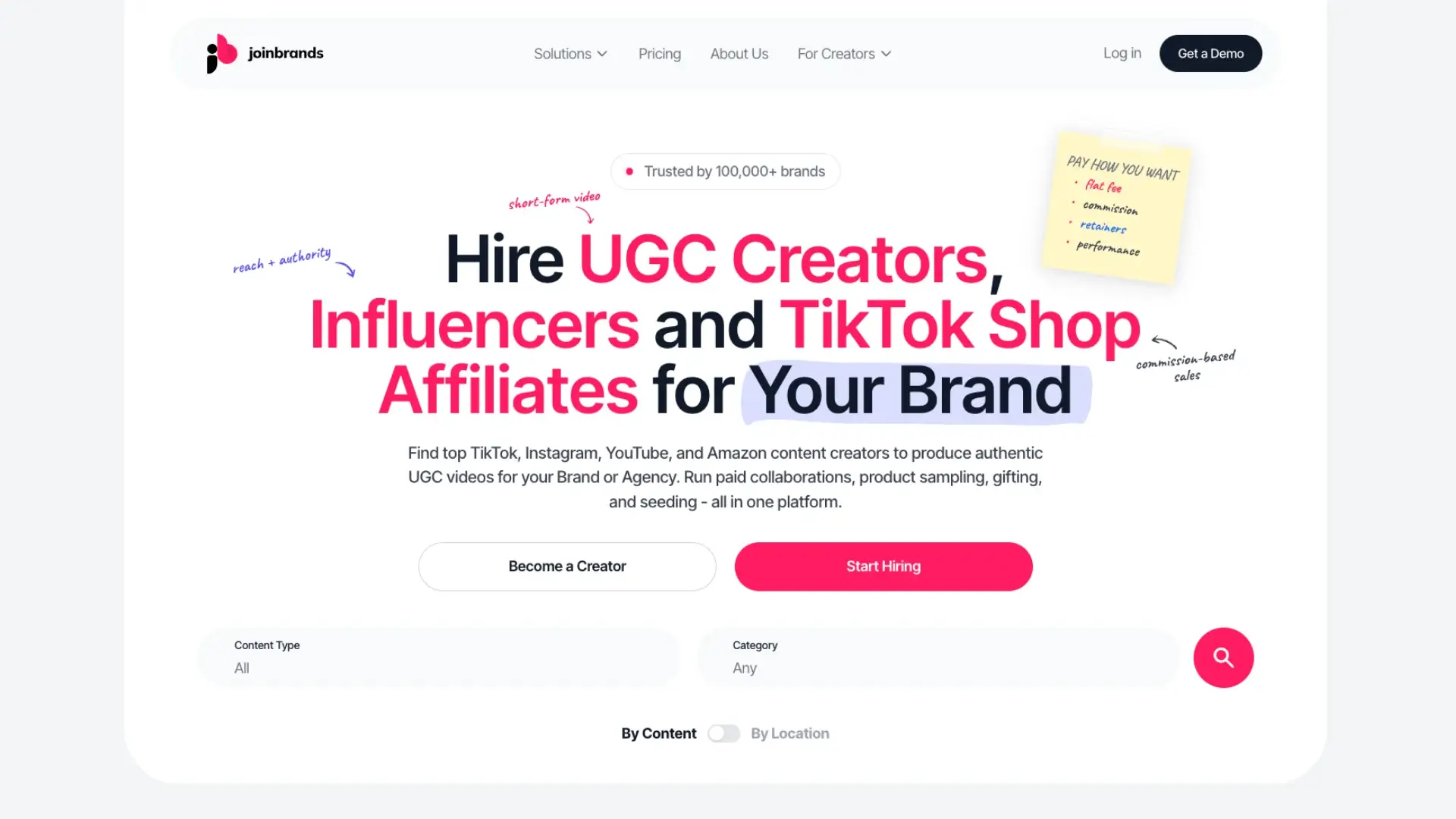
JoinBrands is a UGC and influencer marketplace that helps brands connect with creators, send products, and collect authentic photo and video content. It’s designed to simplify content sourcing by bringing creator discovery, briefing, and delivery into one place.
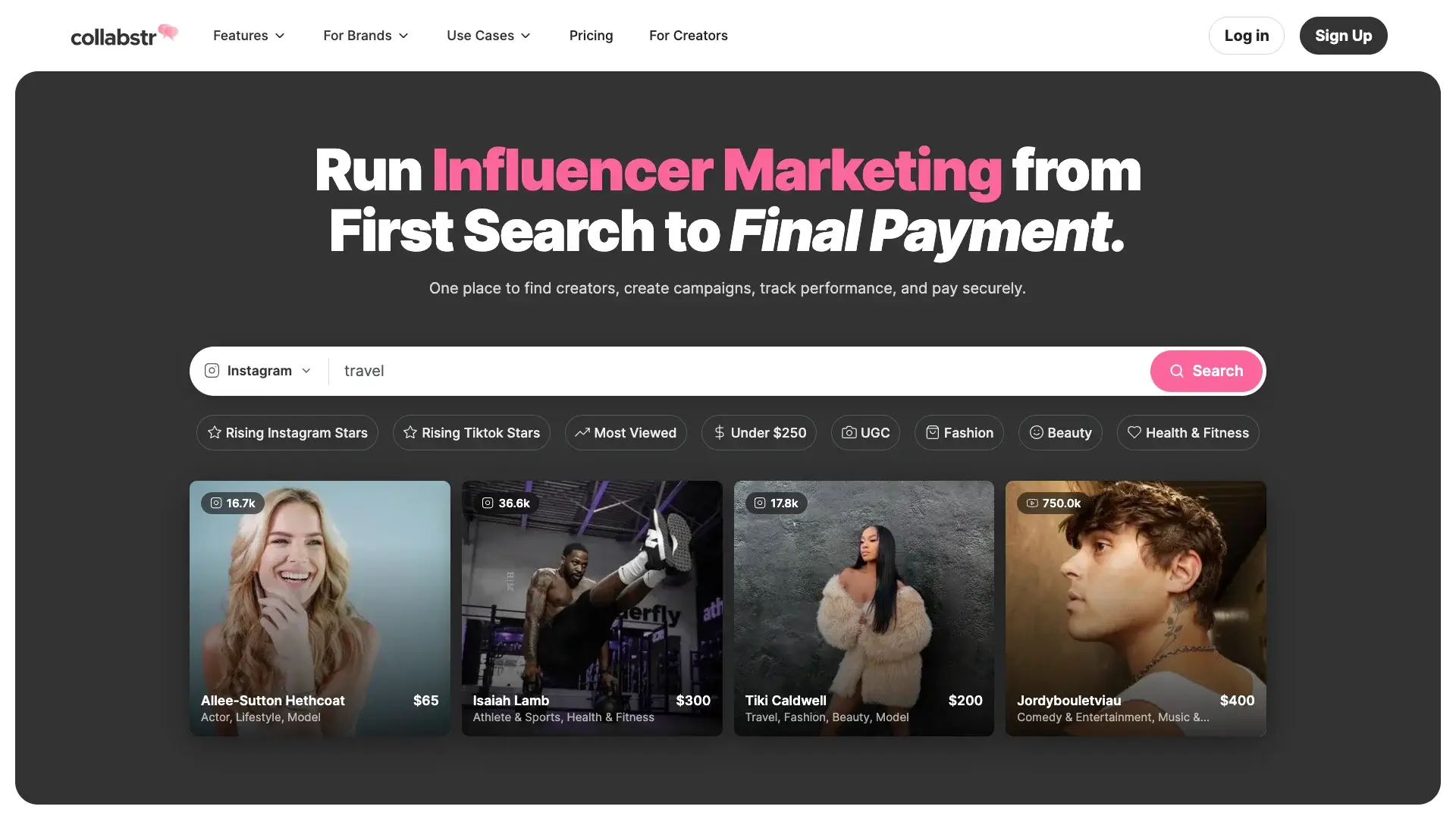
Collabstr is a self-serve marketplace where brands can hire creators on TikTok, Instagram, YouTube, and other platforms to produce sponsored posts or UGC. It’s designed for simplicity, offering transparent pricing, secure payments, and fast turnaround times.
Choosing the right influencer marketing platform depends on your goals, budget, and how your team works. Some brands prioritise discovery and data, while others want an all-in-one tool that also handles UGC, payments, and analytics.
The right platform should simplify your workflow, support your goals, and make influencer marketing feel effortless.
Influencer marketing earns its place because it transforms trust into purchases. Every brand in this guide reaches a warm audience through a creator their customers already follow, and walks away with authentic content to reuse.
The through-line is consistency. The strongest programmes treat creators as a long-term channel rather than a run of one-off transactions.
What decides your return, though, is what happens after the post goes live. Creator content peaks within days, so moving it into your website, product pages, emails, and dynamic ads is what turns a short-lived post into an asset that keeps selling.
Running all of that by hand gets heavy fast. A purpose-built influencer marketing platform keeps discovery, briefing, rights, and measurement in one place, so you can scale collaborations without losing the authenticity that makes them work.