Products
Case studies
Industries
Resources
I’m an Influencer
9 min read


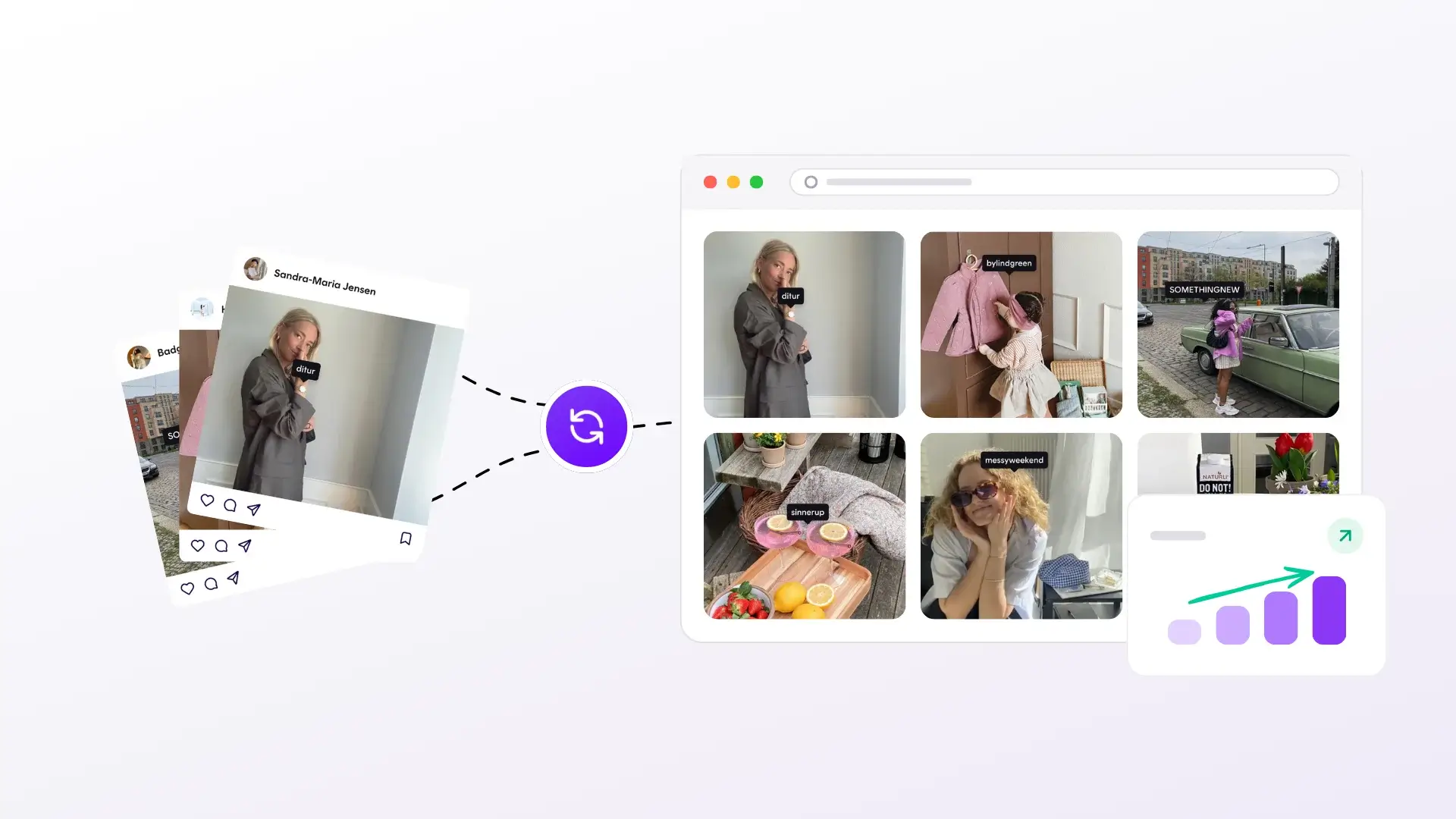
Table of Contents
Many brands face a common challenge with social content: it tends to fade away quickly, often within just a few hours or days. Paid collaborations with influencers are not cheap, which is why they all try to extend the lifespan of their content to increase ROI.
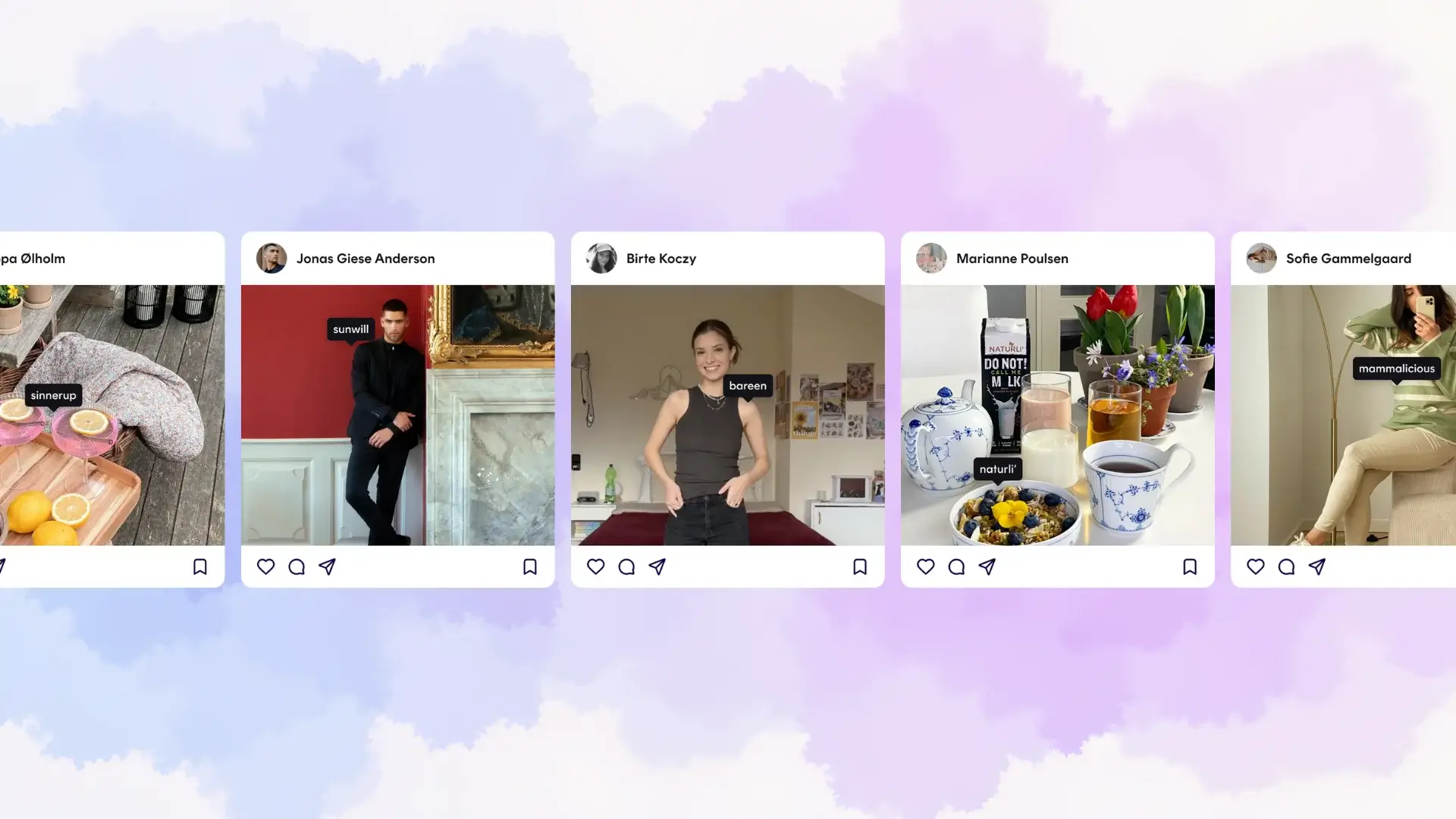
Every day, your team and your community create content that resonates with people. An Instagram post from a customer wearing your product. A Reel from a cosmetic creator you collaborated with. A photo that captures your furniture product in a way no studio shoot could. And within 24 hours, that user-generated content is gone. Not deleted, but invisible, buried under a feed of millions of new posts, stories, and ads.
This is the reality of social media. Your content has an expiration date. No matter how well it performs in the first few hours, it will be replaced. The feed moves on, and your investment in creating that content stops producing returns. But it does not have to be that way. By repurposing your best social content onto your website, ads, email campaigns, etc., you can turn posts with a 24-hour shelf life into assets that drive traffic, trust, and revenue for months.
This article breaks down exactly why social content disappears so quickly, what happens to your revenue when you give it a permanent home, and how brands like Jennifer Taylor Home, Xandres, HelloChair, and Lampemesteren are already proving the results of repurposing UGC across channels.
Social media platforms are not designed to keep your content visible, but to keep users scrolling. Instagram, TikTok, YouTube, Facebook, they all use algorithms that prioritise recency. A post that performs well in its first 2 hours gets pushed to more feeds. After that, it decays rapidly. Even viral posts have a window of days, not weeks. Stories vanish after 24 hours by design. Reels cycle through for a few days at best.
This is not a flaw; it’s the business model. Platforms need fresh content to keep users engaged, which means your old content, no matter how good it was, gets displaced to make room for what is new.
For brands, the consequence is clear: the return on every piece of content you create (branded or via a creator collaboration) is capped by the platform’s attention cycle. You invest in an influencer marketing strategy or even a brand ambassador programme, plan the campaigns, generate high-quality visuals, and the window to see results is measured in hours.
Rowico Home, a Swedish furniture brand, noticed this problem firsthand. Their Instagram feed was full of inspiring customer images, but this valuable content wasn’t being used anywhere other than social media.
“On our own Instagram account, we had a lot of pictures that not enough people saw. Using Flowbox, we could have all those pictures on our website and make them visible for more people.”
Evelina Jensen, E-commerce Manager at Rowico Home
The content existed. The quality was there. But the platform was limiting its reach. The fix was not to create more content. It was to move the best content (branded and community UGC) to a channel they actually owned and controlled: their website.
The results were clear: after repurposing the social content from their community for their website, Rowico Home saw a 52% uplift in average order size and a 67% uplift in average order value. Learn how Rowico Home benefits from UGC.
When content sits on your website instead of a social feed, the economics change fundamentally. On social media, your content competes with millions of other posts for a few seconds of attention. On your website, it lives in a distraction-free environment where visitors already have purchase intent. They are not scrolling. They are browsing, comparing, and deciding.
Jennifer Taylor Home, a US-based furniture brand, experienced this shift directly. They had a large catalogue of customer images from various channels, but no way to showcase them where they mattered most: alongside their product listings on their own website.
“We’ve always had a kind of catalogue of customer images because of the other vendors that sell our products. We basically had all of those resources but no means of posting that on our website. So Flowbox was exactly what we needed to upload those images and showcase them with our product listings.”
Vu Tong, eCommerce Account Manager at Jennifer Taylor Home
After integrating UGC on their product pages with Flowbox, Jennifer Taylor Home measured a 49.7% increase in overall conversion rate. More than one in five visitors (22.06%) actively interacted with the UGC content on their site. Learn how Jennifer Taylor Home benefits from UGC.
What makes this result significant is the permanence. Social posts decay within hours, but UGC on your website keeps working every day, for every new visitor, without additional spend. It is an asset that compounds rather than expires.
The numbers back this up consistently across industries. Here is what Flowbox customers have measured after bringing social content onto their websites:
These are not marginal improvements. They represent real revenue that would have been left on the table if the content had stayed on social media.
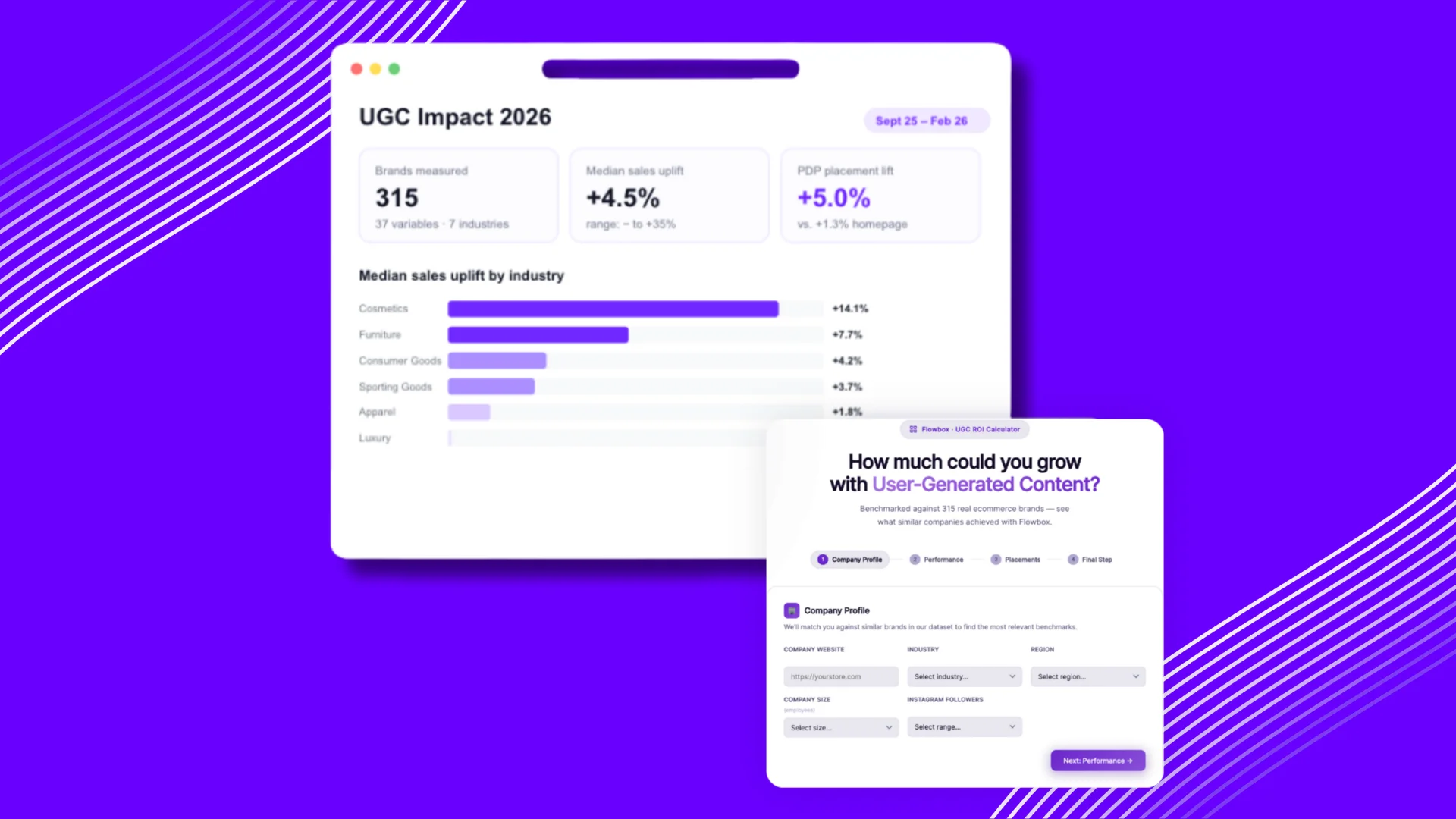
If you are interested in learning more about the results of leading European brands with UGC, this report explores the sales impact of UGC across 315 eCommerce brands. Download the Flowbox UGC Impact Report 2026 or try the ROI Calculator to discover the revenue your brand is missing.
Placing content on your website extends its lifespan. Making that content shoppable extends its revenue impact.
When a visitor sees a photo from a real customer or creator and can click directly to the product in that image, you eliminate the friction between inspiration and purchase. There is no need to search for the product, guess the name, or navigate through menus. One click takes them from “I want that” to “View product”. This is where shoppable UGC galleries make a measurable difference.
HelloChair, a Dutch furniture brand, found that connecting the right products to each UGC post directly influenced their conversion uplift.
“Without the connection, customers are not able to find or they’re not going to buy the item. So it is really important for us to connect the right products to the post. And it really helps us in the uplift of our conversions.”
Inge Bakker, eCommerce Manager at HelloChair
HelloChair saw a 26% uplift in average order size and a 61% increase in average order value after implementing shoppable UGC with Flowbox. Learn how HelloChair benefits from UGC.
Porcelanosa, a global building materials brand, saw a similar effect on their product pages. By adding UGC galleries alongside their professional studio imagery, they gave potential buyers the real-life context that catalogue photos alone cannot provide.
“User-generated content builds trust among potential buyers because they can see how others have chosen the brand and applied the materials in real projects.”
Porcelanosa Communications Team
The result: a 19.7% increase in Flowbox-assisted sales and a 14.07% click-through rate on the “Buy Now” button within UGC galleries. Learn how Porcelanosa benefits from UGC.
The combination of authenticity and a direct path to purchase is what turns passive browsing into buying behaviour.
The most effective content strategies are not about creating more. They are about getting more from what already exists.
Brands with active communities on social media are sitting on a constant stream of authentic content (btw, here is a guide on how to activate your community). The challenge is not supply. It is that the content stays trapped on platforms where its visibility expires.
XXL Nutrition, a Dutch health and fitness brand with a large social following, recognised this gap early.
“We have a lot of followers on our social media accounts, but we never did anything with it. Now we can use the content made by our customers to our advantage. That’s very powerful (…) It’s almost impossible to have multiple pictures for each product. So we have a loyal fan base that can do it, and they do actually do it. So it’s a missed opportunity when we don’t use that content for us.”
Tom Meijer, Online Marketeer at XXL Nutrition
After implementing Flowbox, XXL Nutrition saw an 87.98% increase in average order value and a 112.72% increase in average order size among visitors who interacted with UGC on their website. The content that was sitting idle on social media became one of the most effective revenue drivers on their site. Learn how XXL Nutrition benefits from UGC.
EVOC Sports, a German cycling gear brand, had the same realisation. Their community was constantly sending in photos of their products in action, but most of that content ended up buried in an inbox with no way to make it visible. Learn how EVOC Sports benefits from UGC.
“We often received pictures from the community, but most of them just ended up in our inbox and didn’t have a place to be published and seen by others. So it was a great solution that we’re now able to promote and gather this content using Flowbox.”
Maxi Ortmeier, Senior Performance Marketing & E-Commerce Manager at EVOC
The pattern across these brands is consistent. The content already exists. The community is already engaged. The missing piece is the system that collects, curates, and distributes that content to the places where it generates the most value: product pages, homepages, category pages, social ads, and email campaigns.
And as Kids Brand Store, a Nordic children’s fashion retailer, discovered, having that system in place also changes how efficiently the team operates.
“In Flowbox Moderate, we can gather all of our photos in one place and use tags to filter them, it saves us a lot of time. It’s easy to get an overview of our content and we can also tag the products in each photo to drive conversions which is something we couldn’t do before Flowbox.”
Malin Ganebro, Social Media & Influencer Marketing Manager at Kids Brand Store
Kids Brand Store went on to measure a 200% increase in average order value and a 13.8% higher conversion rate with UGC ads compared to branded content. Learn how Kids Brand Store benefits from UGC.
Not all pages on your website are equally valuable for UGC. Placement determines whether repurposed content merely exists on your site or actively drives results.
Homepage galleries are the most common starting point. They create an immediate sense of community and authenticity when visitors land on your site.
Vintage Jewellery, Timi of Sweden, and Naturitas all use homepage placements to introduce visitors to real customer content from the first scroll.
Naturitas has seen an average order value increase of 21.76%, and users who interact with UGC convert x3.7 more. Learn how Naturitas benefits from UGC.
“Overall, we have had a very positive experience. We implemented the carousel widgets on the homepage, the food landing page, and the supplementation page. We have also implemented a UGC gallery on a page dedicated to our community. We have seen great results and increased visits to the home page widgets. Within the food pages, we have also noticed that the conversion rates have increased.”
Victoria Robles, CRM Specialist at Naturitas
Product pages tend to deliver the strongest conversion impact. This is where buyers are making decisions, and seeing a product in a real setting alongside the studio shot can tip the scale.
Murwal, Franklin and CREATE also showcase UGC on their product pages.
CREATE, a Spanish home appliance brand, implemented UGC flows across their homepage, community page, and product pages, with 10.7% of users who interacted with product-linked UGC clicking through to the “See Product” button. Learn how CREATE benefits from UGC.
“The flows implemented on product pages give us the best results. These pages have high traffic, and users can see specific content about the product they’re interested in. Additionally, it’s the flow closest to purchase, while the homepage flow works as an entry point that invites consumers to create content and get to know our brand.”
Pedro Salazar, Digital Director at CREATE
Category and inspiration pages help visitors explore. Brands like Sonne und Strand, The Beautiful Bride Shop, and Holdit use UGC across category pages, 404 pages and even their sustainability pages, ensuring customers encounter authentic content throughout the shopping journey. But the most commonly used page for inspiration is definitely the community page. Take the example of Sklum.
Sklum, a Spanish design furniture brand, takes a similar approach with a dedicated community page that showcases curated customer content alongside their product catalogue, achieving a 16.1% CTR on community content and a 13.8% click-through to product pages. Learn how Sklum benefits from UGC.
“We believe that UGC is organic and authentic content that builds trust in the brand (…) The engagement generated by the UGC carousels is high, and the platform is giving us very good results.”
Oana Andrada, CMO at Sklum
The key is strategic coverage. Place product-specific UGC on the product pages where purchase decisions happen, and use broader galleries on pages designed for discovery and engagement, like the homepage and the community page.
Getting content onto your website is only half the job. Doing it poorly wastes the opportunity.
The content your brand and community produce is worth far more than a 24-hour window of visibility. By collecting your strongest social content, curating it for your website, and making it shoppable, you turn something disposable into something that generates revenue every day.
Flowbox gives you one platform to manage this entire workflow: collect content from social media, curate and approve it, embed it across your website in shoppable galleries, and track the revenue it generates. The brands in this article are already seeing the results.
Want to see how this works for your brand? Request a demo and discover how Flowbox can help you boost the revenue of your UGC strategy.