Products
Case studies
Industries
Resources
I’m an Influencer
13 min read


Table of Contents
This section is for general information only and is not legal advice. Regulations differ by country and change over time. Confirm your obligations with a qualified legal professional before running a campaign.
Influencer content licensing is the gateway between admiring an influencer’s post and actually being allowed to use it. Every brand that runs influencer marketing ultimately faces the same scenario: an influencer video reaches new audiences, builds awareness and sells the product, and the instinct is to put it everywhere. That instinct can spark trouble.
Influencer content is not yours simply because it features your product or brand, not even when you paid for the collaboration. Using it across your website, ads, and email requires a documented right to do so. But for brands scaling their UGC and influencer marketing strategy, manually requesting the rights and being compliant can be challenging.
This guide explains who owns influencer content by default, what a usable licence has to cover, how the rules diverge between the EU, the UK and the US, and where content licensing overlaps with advertising disclosure. It is written for marketing managers who commission creator content and then want to use it across their owned channels through an influencer marketing platform.
And if you are not yet investing in influencer marketing, this is your signal to do so: learn 7 data-backed benefits of influencer marketing for eCommerce brands.
Influencer content licensing is the legal agreement in which a creator grants permission to use their content for defined purposes, over a defined period, across defined channels, usually in exchange for compensation. The influencer keeps the copyright and intellectual property, and the brand gets a licence to repurpose the content within agreed limits.
Licensing matters for one reason that holds across regions: the person who creates the content initially owns the copyright, meaning they hold the exclusive right to reproduce and distribute it. A brand featured in the content does not automatically inherit that right.
Copyright also arises automatically. The same source confirms protection is automatic from the moment of the work’s creation, with no registration or formality required. A creator owns their photo or video the instant they make it.
Paying an influencer to post content does not transfer copyright. The creator remains the owner unless they grant you rights in an agreement.
Reposting a story to your own feed is one thing. Putting the same clip into a paid ad, an email flow, or a product page is a different scale of use, and it usually requires broader rights than a casual tag implies.
Under EU law, reproduction and communication to the public are separate exclusive rights of the author (InfoSoc Directive 2001/29/EC, Articles 2 and 3). Using the post without a licence is prima facie infringement of those rights, even though you paid for the original post.
This is the most common and most avoidable mistake in influencer marketing. It is also the easiest to fix, because it is solved by agreement before the content goes live, not after. Understanding UGC creator vs influencer content is also vital here, as permission shifts depending on who made the content and under what arrangement.
Licensing rules have tightened because creator content now sits inside several bodies of law that have all moved the same way. None of them is copyright, but each one raises the cost of getting a collaboration wrong, and each one belongs in the licensing agreement.
An influencer content licence needs to define four things at minimum: where the content can appear, for how long, whether it can be edited, and whether it can be used in paid ads. Each of these maps to a separate right, so leaving one unstated leaves a gap.
The European Commission’s influencer IP brief confirms that licences may be limited by territory and by type of use, and that authorisation to use protected content must be obtained from the rights holder.
Here is what each element controls in practice:
Overcomplicating an agreement can overwhelm a creator and slow the whole collaboration. A simple set of terms that protects both sides does the hard work.
Creators within the Flowbox network have already accepted the Terms and Conditions. By accepting those terms, a creator grants a licence for the image and video content produced for a campaign to be used for marketing, extending to the brand as the platform’s business partner, defaulting to up to 24 months from upload unless the campaign brief sets a different period.
Creators separately agree to keep a sponsored post live on their own profile for at least three months, and to use only music cleared for commercial use, which helps avoid a common rights issue in video content.
You can also customise these elements in the platform briefing tool, and establish different conditions per campaign.
A licence for organic use does not automatically cover paid ads. This is the single most expensive assumption in influencer content licensing.
Running a creator’s post as a paid ad, or amplifying it through allowlisting (sometimes called whitelisting), is a distinct commercial use. It puts the content in front of an audience the creator never agreed to reach, in a context they never agreed to. If your licence only granted organic reposting, paid amplification is outside it.
The fix is to name paid media explicitly in the grant, alongside the channels and the duration. If you intend to boost it, the agreement has to say so before the campaign starts.
Licensing and advertising disclosure are separate obligations that stack on top of each other. A perfectly licensed repost can still be unlawful if the ad label is missing, and a perfectly labelled post can still infringe copyright if the licence is missing.
In the EU, undisclosed paid content is banned outright. The Unfair Commercial Practices Directive treats a failure to disclose commercial intent as a misleading omission (Directive 2005/29/EC, Article 7), and its blacklist bans presenting paid-for editorial content as independent without making the payment clear (Annex I, point 11). The European Commission runs an Influencer Legal Hub to help brands and creators apply these rules.
Liability can reach the brand, not only the creator. Because an influencer promoting for payment is treated as a ‘trader’ under the UCPD, the obligation is shared, a point set out in the European Parliament research briefing on regulating influencer marketing in the EU (EPRS briefing PE 779254). That briefing also notes a 2024 EU-wide sweep found only 5.4% of influencer posts were labelled as advertising.
In the UK, the ASA and CAP require any paid or incentivised content to be clearly identifiable as an ad, with labels such as ‘ad’ placed upfront (ASA guidance). Enforcement has sharpened: under the Digital Markets, Competition and Consumers Act 2024, the CMA’s consumer regime came into force on 6 April 2025 (SI 2025/267).
In the US, the FTC requires disclosure of any material connection between a brand and an endorser, and both the advertiser and the endorser can be liable (16 CFR Part 255).
The first-owner principle is shared, but the contract mechanics diverge once you leave the EU. Flowbox is a European company, and the EU framework above is the spine, but many brands run the same creator content into the UK and the US, where two differences matter.
In the UK, the author is the first owner of copyright, and there is no automatic exception for commissioned work. Section 11 of the Copyright, Designs and Patents Act 1988 makes the author the first owner, except for works made by an employee in the course of employment. An independent creator is not your employee, so you need a written assignment or licence.
UK moral rights also behave differently from the continental default. They must be asserted to take effect, and they can be waived in writing. The Act allows any of these rights to be given up by a signed written instrument, covering specific works or works generally (CDPA 1988, s.87). This is why UK-facing creator contracts often include a moral-rights waiver that would not hold in much of the EU.
In the US, an independent creator generally keeps the copyright unless there is a written assignment, because “work made for hire” is narrower than it sounds. The doctrine covers work by an employee within their employment, or a specially commissioned work that both falls within nine specific categories and is agreed in a signed writing to be work made for hire (US Copyright Office, Circular 30, 17 U.S.C. 101 and 201).
Ordinary influencer content, such as a social video or a lifestyle photo, usually does not fit those nine categories. So even a signed “work made for hire” clause often does not transfer ownership on its own. The reliable route is a written copyright assignment or a clear licence.
Federal moral rights under the Visual Artists Rights Act apply only to narrow categories of fine visual art, such as limited-edition photographs made for exhibition (17 U.S.C. 106A). For everyday marketing content, attribution and integrity are contractual matters in the US, not statutory ones. This is the sharpest contrast with the EU.
Flowbox turns the licensing principles above into a workflow, so rights are secured and recorded rather than assumed. It does not replace legal advice or contracts, and it says so plainly, but it removes the manual gaps where rights usually go missing.
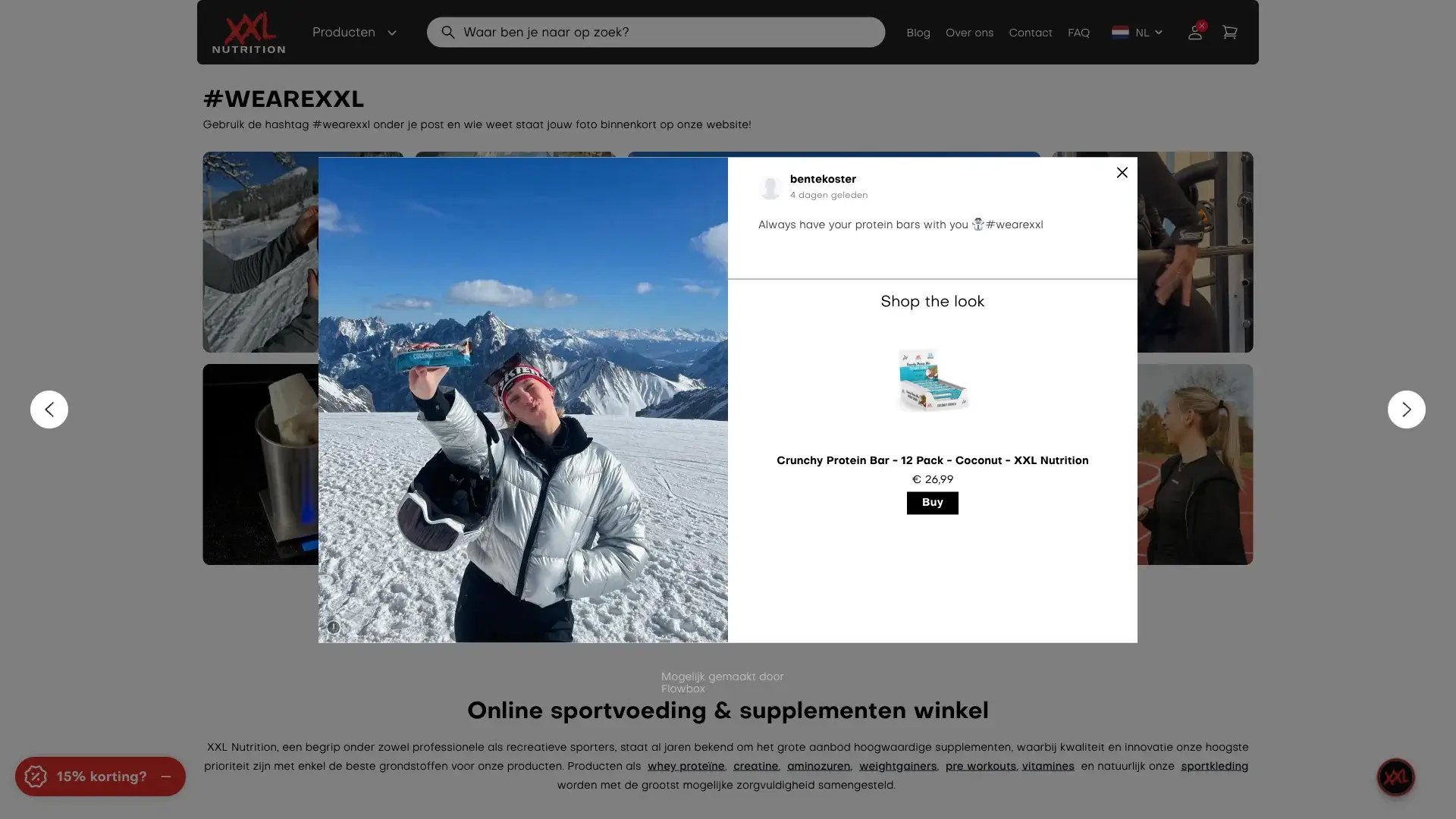
Flowbox’s Rights Management module lets you request usage rights for Instagram and TikTok posts by comment or DM (all through the same dashboard), then tracks each request through clear statuses from pending to granted, declined, or expired. You can set content to auto-approve once rights come back granted, so nothing goes live before permission does.
A rights request is a formal ask for permission to use a specific piece of content, with the creator’s reply serving as your record. Done manually, you DM the creator or comment on the post, screenshot the yes, download the file, and store it somewhere you hope you will find again.
Through Flowbox, a permission becomes a tracked, searchable status rather than a screenshot on someone’s phone. It helps you request and manage rights for Instagram and TikTok posts via Comment or DM, and you can also mark content as ‘Self-granted’ (if you own the content) or have posts ‘Whitelisted’ (for regular collaborators with signed agreements).
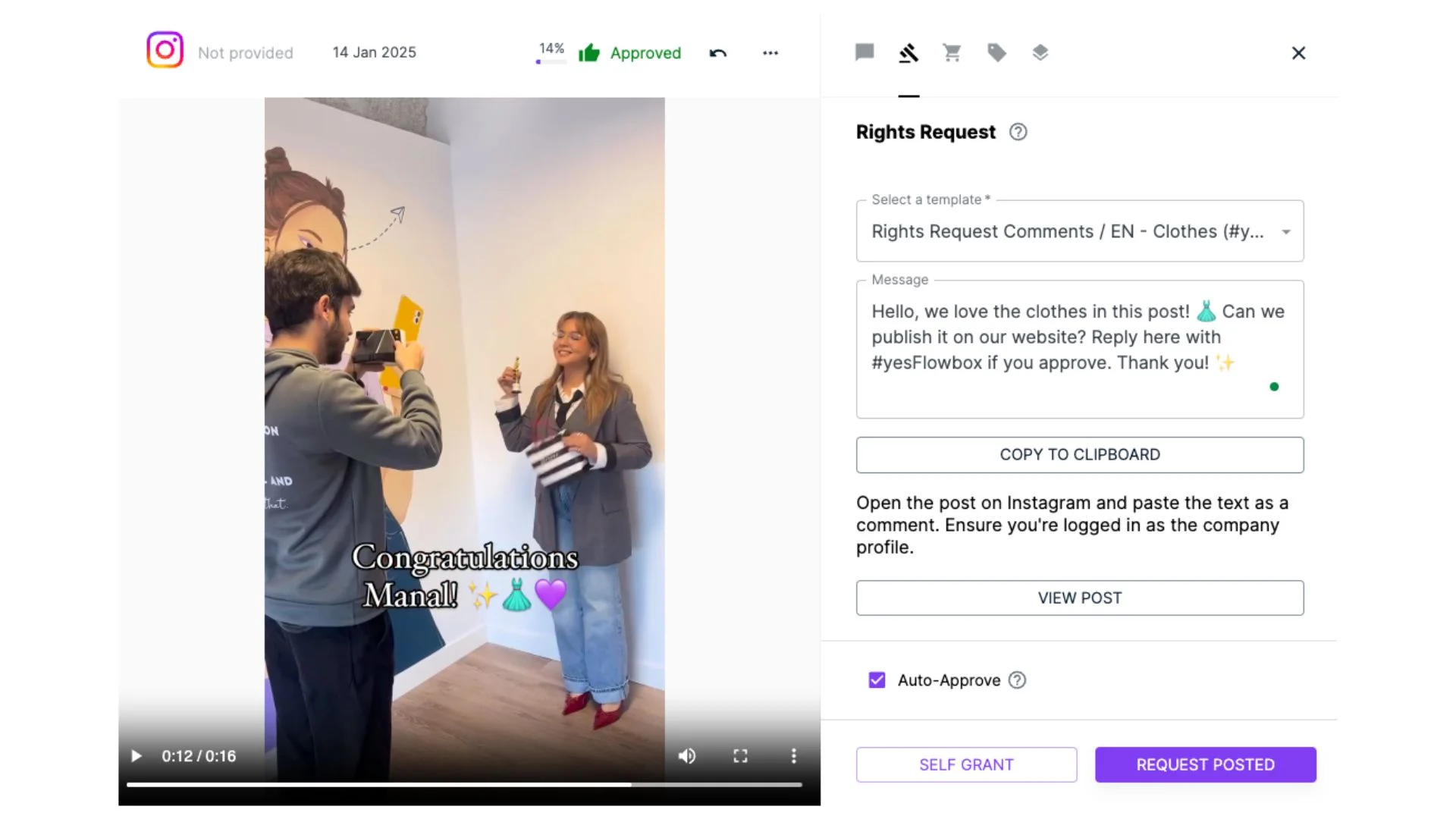
Each request moves through clear stages from pending to granted, and content can be auto-approved the moment a creator replies with your agreed hashtag. To understand the full process, check out our article explaining how Flowbox can help you obtain permission in detail.
Rowico Home uses the request itself as a signal to their community. As Linnéa Sollin, E-commerce Coordinator at Rowico Home, explained:
“We only use Rights Requests for Instagram right now, and it works really well. It’s where we manage and collect all the photos and videos. We mostly send the Rights Requests via comments because we like to show other creators that we actually send out requests. So more people can see that we appreciate and share their content.”
Linnéa Sollin, E-commerce Coordinator at Rowico Home
They’ve found the rights request feature in Flowbox useful, and it has helped keep their inspiration page fresh.
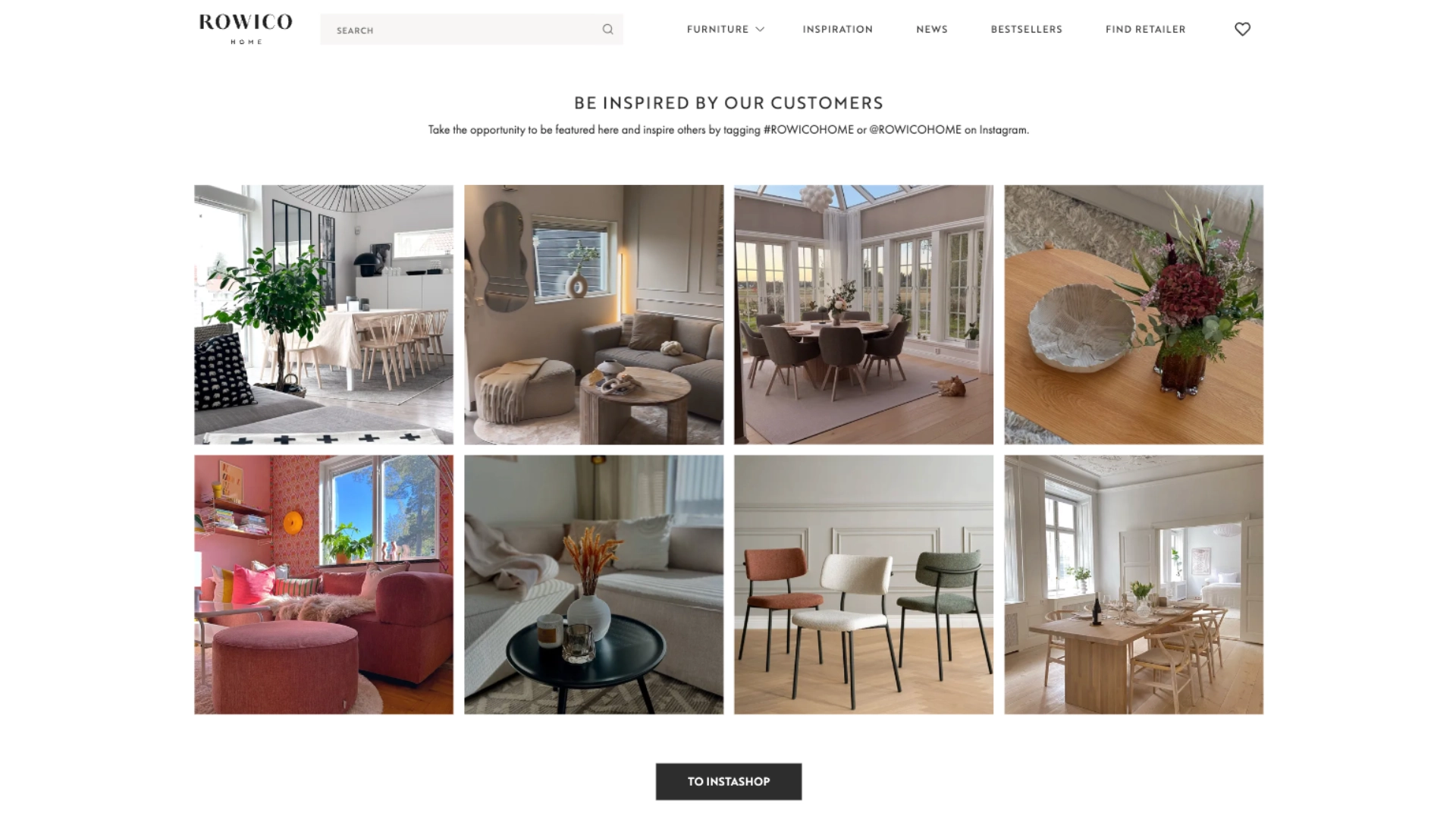
By using the Flowbox rights request feature, Rowico Home has been able to showcase their furniture authentically while remaining compliant. Read the Rowico Home case study to learn more.
Securing the right to use content is one gate. Deciding what actually publishes is another, and Flowbox’s content approval keeps the two separate so nothing reaches your site by accident. With pre-approval moderation switched on, collected content passes through two hands before it goes live.
A moderator, often a junior team member, reviews incoming posts and pre-approves the ones that fit, and an admin then gives the final approval for what appears on your website. You can pre-approve in bulk, and any pre-approval can be reverted back to the inbox if a second look changes your mind.
The approval step and the rights step sit next to each other in the same place, which is what lets a reviewer clear a post and request its usage rights in one move. Approved content updates in near real time, so a cleared image can appear in your gallery straight away.
St Maclou displays UGC on category pages like parquet and carpet to help shoppers picture a product at home, so those galleries only work if approving content is quick and clear. As Juliette Labarre, Brand Content Manager at St Maclou, put it:
“As soon as an image is approved, it appears right away on the flow. I would also really highlight the moderation tools: it’s simple, effective, everything is visual with green for ‘approved’, red for ‘rejected’… It’s super intuitive and easy to use.”
Juliette Labarre, Brand Content Manager at St Maclou
Because approving a post and clearing its rights happen in the same visual workflow, St Maclou keeps a live, on-brand gallery without the moderation step becoming a bottleneck. Read the St Maclou case study to learn more.
Whitelisting a creator’s handle marks their future posts as cleared, so you don’t need to send a new request every time. Offered through Flowbox, it turns a recurring per-post task into a one-time setup for the creators you work with again and again.
Flowbox is explicit that you must have the creator’s consent before you do this, which keeps the practice aligned with the consent principle behind licensing.
Whitelisting tells Flowbox to treat a specific creator as pre-approved. You add the creator’s Instagram or TikTok handle to your whitelist in the dashboard, and from then on any new content collected from that profile is automatically labelled ‘Whitelisted’, so it does not need a separate rights request.
The consent step comes first, not after. Before you whitelist a handle, you need explicit permission from the account owner, who must understand that their future posts may be collected and published through the platform. Whitelisting speeds up how you use the right, but it does not replace the right itself.
Flowbox can also auto-tag each whitelisted creator’s posts with their username, which lets you build dynamic galleries that spotlight a specific creator or partner. This is how some brands run a dedicated creator feed, especially for brand ambassador programmes.
Contura works with a large roster of creators, and the biggest channels were the slowest to reply, which is exactly where a per-post permission model breaks down first. Whitelisting removed that wait. As Jack Gustafsson, Webmaster at Contura, described it:
“The whitelisted feature saves time. Sometimes you have to wait a very long time for the creator to reply and get their permission to use their images, especially if it’s a bigger channel. They can’t see every comment and so on. It’s just easier and saves time (…) The users that we have whitelisted are mostly users that share content regularly.”
Jack Gustafsson, Webmaster at Contura
With more than 45 whitelisted creators, Contura reuses partner content across channels without restarting the permission process each time.
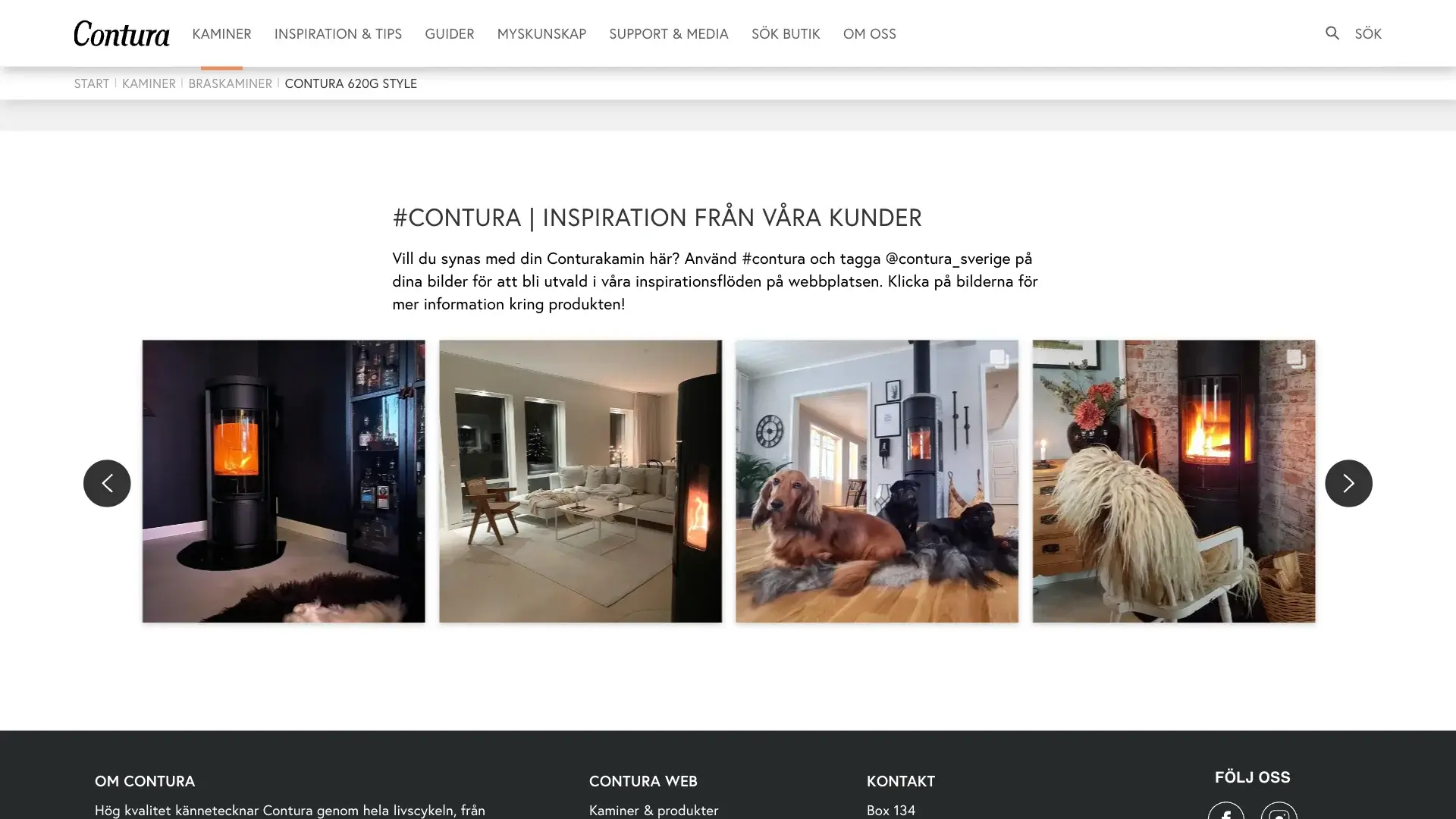
By whitelisting the creators they collaborate with, Contura turned a stop-start approval cycle into a standing arrangement, so the content is ready to use as soon as it’s collected. Read the Contura case study to learn more.
Flowbox’s influencer marketing platform handles rights through creator general terms and conditions, in addition to the specific campaign requests. By accepting those terms, a creator grants a licence to use the campaign content for marketing, defaulting to up to 24 months from upload unless the brief sets a different period.
Creators also agree to keep a sponsored post live for at least three months and to use only music cleared for commercial use, which closes a common rights gap in video. The same terms set the collaboration as an independent-contractor relationship, so creators handle their own tax on fees, gifts and vouchers, and each campaign brief adds the specific deliverables, hashtags and deadlines on top of the general baseline.
Because the licence, the disclosure duty and the visibility commitment are all fixed before a single post goes out, a campaign starts from a written baseline rather than a loose DM agreement.
The content approval step in a campaign lets you review a creator’s work while it is still a draft, before it is ever posted. You can turn it on for a campaign and describe what you are looking for, so creators see your expectations before and after they join. Instead of posting straight away, each participant uploads their content as a draft for your review.
From there, you either approve the draft or request changes, with your feedback attached to the submission itself. The creator uploads a revised version, and you can run as many rounds as you need, with the whole loop staying on the platform rather than scattered across email or DMs.
Once you approve, the creator posts, and both sides see the same status at every step, from first upload to live. Because the review happens while the content is still a draft, it doubles as a compliance safeguard, since you can check the brief and the disclosure label before anything is public rather than after.
Content approval is optional per campaign, so you can require it where review matters and skip it where speed matters more.
The market for influencer tools is crowded, with a specialised option for almost every task. If you need a focused solution for one part of the process, there are capable platforms in each category.
The brands that win with influencer content are the ones that stop treating campaigns, rights, and payments as separate projects. They run one pipeline, hold every licence and asset in one centralised library, and keep permission, payment, and reporting connected rather than scattered across contracts and dashboards.
Flowbox’s platforms enable this, making direct alternatives difficult to find.
Ready to see how a unified influencer platform changes what your team can do? Request a demo and join 1,000+ brands already scaling authentic content with Flowbox.
No. Paying for a collaboration or being featured in a post doesn’t transfer copyright. The creator remains the initial copyright owner and holds the exclusive right to reproduce and distribute the work. Your brand needs a granted licence or written agreement to use it beyond the original post.
Only if your licence covers paid media. A grant for organic use does not automatically extend to paid amplification or allowlisting, which is a separate commercial use. Name paid ads explicitly in the licence before the campaign runs.
At minimum: the channels the content can appear on, the territory, the duration, whether it can be edited, whether it can run as advertising, exclusivity, and how the right renews. The European Commission confirms licences can be limited by territory and type of use.
It depends on the agreement. Under Flowbox’s baseline influencer terms, an influencer grants permission to use their image and video material for marketing and PR purposes for up to 24 months after upload, unless a specific campaign states otherwise.
Whitelisting means an influencer has pre-approved you to reuse their content across channels without asking permission each time. A rights request asks permission for one specific piece of content. Whitelisting grants standing approval once, which is especially valuable with larger creators who are slow to reply. You still need the creator’s consent before whitelisting them.
It doesn’t need to be exhaustive; just clear enough to prevent disputes. A solid agreement covers scope of use, channels, duration, exclusivity, paid amplification rights, disclosure responsibility, and renewal terms.